

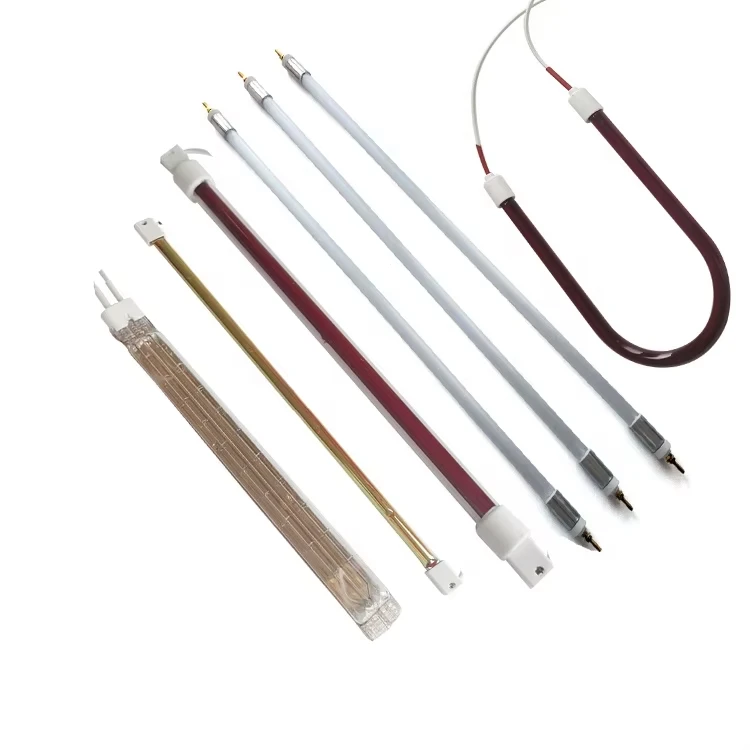
Quartz infrared heating lamps are high-density radiant energy sources utilizing clear or translucent quartz glass tubes housing high-purity tungsten or woven carbon fiber filaments. Unlike convective air systems that heat process atmospheres, radiant infrared energy transfers heat directly to the target substrate via electromagnetic radiation, reaching full power output in seconds.
In high-speed processing lines-such as PET bottle stretch blow molding, automotive paint curing, paper drying, and silicon wafer annealing-convective heating is too slow and energy-inefficient. However, selecting the wrong infrared wavelength results in surface scorching, internal under-curing, or massive energy loss due to transmission through transparent materials. This guide establishes the optical physics of wavelength matching, filament selection, directional reflector coatings, and system integration.
1. Wavelength Physics, Wien's Displacement Law, and Spectral Absorption
Infrared thermal radiation intensity and peak emission wavelength (λpeak) are governed by Planck's Law and Wien's Displacement Law:
λpeak = b/T = (2898μm•K)/Tfilament
Where Tfilament is the absolute filament temperature (K) and b is Wien's displacement constant.
| IR Spectrum Wave | Filament Temp (°C/K) | Peak Wavelength (µm) | Primary Material Absorption |
|---|---|---|---|
| Shortwave (Halogen) | 1800 - 2400°C / 2600K | 0.9 – 1.4 µm (Near-IR) | Metals, thin glass, deep PET |
| Fast Medium-Wave | 1400 - 1800°C / 1900K | 1.4 – 2.0 µm | Water evaporation, plastics |
| Medium-Wave Carbon | 800 - 1200°C / 1300K | 2.0 – 3.5 µm (Mid-IR) | Polymers, organics, paints |
Optical Matching Principle: Most organic polymers, water molecules, and powder coatings exhibit fundamental molecular vibration absorption bands in the medium-wave spectrum (2.0 - 4.0μm). Utilizing shortwave radiation on polymers often causes radiation to pass straight through without absorption, wasting electrical energy.
2. Filament Technology: Halogen Tungsten vs. Woven Carbon Fiber
The choice of filament material dictates thermal inertia, lamp lifetime, and directional efficiency.
Halogen Shortwave Tungsten : Utilizes a coiled tungsten filament encased in halogen gas (argon/iodine). The internal halogen cycle redeposits evaporated tungsten back onto the filament, allowing operating temperatures up to 2200℃ with sub-second thermal response times (<1 second).

Carbon Fiber Medium-Wave : Utilizes a flexible woven carbon fiber tape. Carbon exhibits near blackbody emissivity (ε≈ 0.95), converting over 90% of electrical energy into targeted medium-wave radiation (2.0 - 3.5μm). It offers superior energy savings when curing water-based paints and thermoplastic sheets compared to tungsten.

3. Reflective Coatings & Directional Flux Control
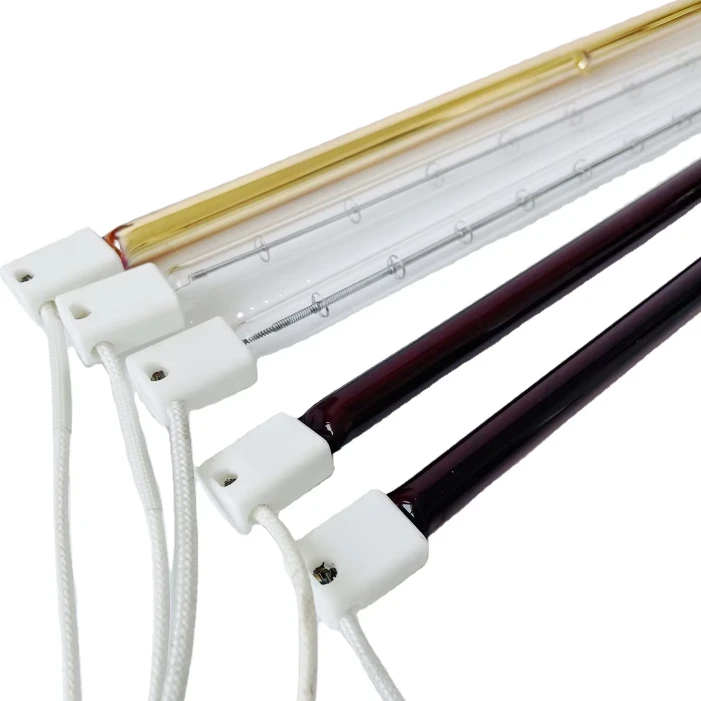
Uncoated quartz tubes radiate thermal energy in a 360° radial pattern, wasting half the output toward the rear reflector casing. Integrated 180° back-coatings redirect backward radiation toward the workpiece.
Gold Reflector : A thin layer of 24-karat gold fused directly onto the rear quartz wall. Gold offers the highest reflectivity in the infrared spectrum (>95% reflection efficiency for wavelengths >1.0μm). Maximum outer tube operating temperature is limited to 800℃ to prevent gold volatilization.
White Ceramic Reflector : High-purity aluminum oxide (Al2O3) ceramic slurry fused onto the tube. Provides ~ 90% diffuse reflectivity, withstands tube wall temperatures up to 1000℃+, and is immune to mechanical scratching and chemical attack.
Twin-Tube Quartz Architecture : High-power emitters utilize "H-shaped" or "Figure-8" twin-tube quartz profiles, offering extreme structural resistance against bending/sagging over spans up to 3 meters.
4. Thermal Sizing, Electrical Loading, and Closed-Loop Control
Sizing infrared heating arrays requires calculating radiant flux density (W/cm2) and matching line speed with thermal ramp rates.
Managing Inrush Current: Tungsten filaments have a cold resistance up to 10× lower than hot operating resistance. Power control panels must employ SCR phase-angle power controllers equipped with soft-start current limiters to prevent tripping circuit breakers during cold start.
Thermal Calculations: When calculating element surface loading and linear power density (W/cm), cross-reference our foundational framework on surface watt density limits and heat flux calculations .
Control Sensors: Closed-loop control relies on fast-response infrared pyrometers or internal sensor probes. For standard thermocouple calibration and junction choices, consult integrated Type K and Type J thermocouples .
Technology Comparison: For non-luminous, heavy-duty ceramic radiant sources, compare quartz emitters with The Engineer's Guide to Ceramic Infrared Heaters . For forced-convection process loops, review Finned Tubular Air Heaters – Thermal Efficiency.
5. Field Failure Modes & Engineering Best Practices
Reflector Volatilization & Contamination : Fingerprints or oil residues on the quartz sleeve absorb infrared energy, creating localized thermal stress hotspots that cause the quartz glass to devitrify (crystallize and crack). Solution: Clean quartz tubes with isopropyl alcohol before energizing, and wear lint-free cotton gloves during installation.
Horizontal Filament Sagging in High-Temperature Emitters : Long shortwave lamps installed horizontally can experience tungsten filament sag over time, causing turn-to-turn short circuits. Solution: Mandate internal filament support rings spaced every $50 - 100\,\text{mm}$ along the quartz tube length.
If your high-speed curing oven, PET blow molding machine, or semiconductor radiant heating line requires custom quartz lamp geometries, twin-tube designs, specialized gold/ceramic reflectors, or SCR power control modules, click the button below to connect with our senior thermal engineering team.