

Unlike convection or conduction heating, which relies on intermediate air volumes or direct physical contact, industrial infrared heating transfers energy directly through electromagnetic waves. Understanding how infrared radiation works-specifically the interplay between wavelength bands, surface emissivity, and substrate absorption spectra-is critical to eliminating thermal bottlenecks and reducing energy waste on automated processing lines.
To maximize radiant heat transfer efficiency, Hongtai Alloy factory manufactures custom-engineered Hongtai infrared heaters. Utilizing optimized resistance filaments, precision quartz glass, ceramic emissive substrates, and integrated reflective coatings, Hongtai radiant heaters deliver:
Direct Electromagnetic Transfer: Up to 90%+ radiant efficiency without preheating process air.
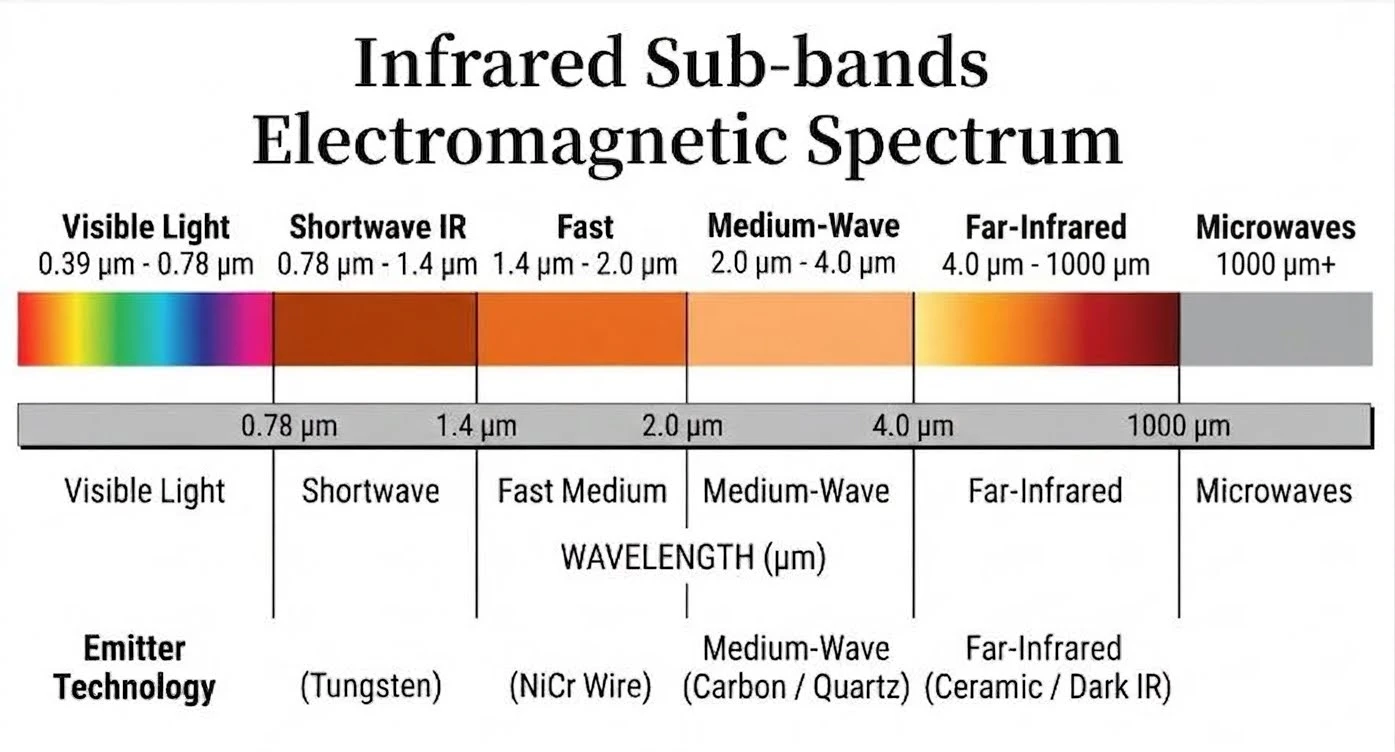
Tuned Wavelength Bands: Spectral matching across shortwave (0.78–1.4 µm), fast medium-wave (1.4–2.0 µm), medium-wave (2.0–4.0 µm), and long-wave (> 4.0 µm) regimes.
High-Emissivity Coatings: Advanced surface treatments reaching emissivity coefficients above 0.92 for near-ideal thermal radiation.
1. The Physics of Infrared Thermal Radiation
Infrared radiation operates under fundamental thermodynamic principles governing energy emission and absorption across the electromagnetic spectrum.
1.1 Electromagnetic Wave Transmission
Thermal radiation travels in straight lines at the speed of light. When an electrical current energizes an internal filament or element, it excites atomic particles, causing them to emit photons in the infrared waveband (0.78 µm to 1000 µm).
1.2 Planck's Law & Energy Density
Planck's Law dictates that as an emitter's operating temperature increases, its total spectral energy density rises rapidly while its peak output shifts toward shorter wavelengths:
E(λ, T) = (2 • h • c²) / (λ⁵ • (exp(h • c / (λ •k • T)) - 1))
h: Planck's constant (6.626 × 10⁻³⁴ J·s)
c: Speed of light (3.0 × 10⁸ m/s)
k: Boltzmann's constant (1.381 × 10⁻²³ J/K)
λ: Target wavelength (m)
T: Absolute temperature (K)
1.3 Stefan-Boltzmann Fourth-Power Scaling
The total radiant power emitted by an infrared heater increases exponentially with absolute temperature:
P = ε •σ • A • (Temitter⁴ - Ttarget⁴)
P: Radiant power output (Watts)
ε: Surface emissivity coefficient (0 to 1.0)
σ: Stefan-Boltzmann constant (5.670 × 10⁻⁸ W/(m²·K⁴))
A: Active emitting surface area (m²)
Because output scales with the fourth power of temperature (T⁴), slight temperature increases yield massive performance gains in radiant heat flux.
For industrial tooling requiring direct contact conduction instead of non-contact infrared radiation, engineers should review High-Density Cartridge Heaters: Precision Mold Engineering Guide.
2. Spectral Wavelength Matching & Peak Emission
Choosing the correct infrared wavelength band determines whether heat penetrates deep into a material or converts instantly on its surface.
2.1 Wien's Displacement Law
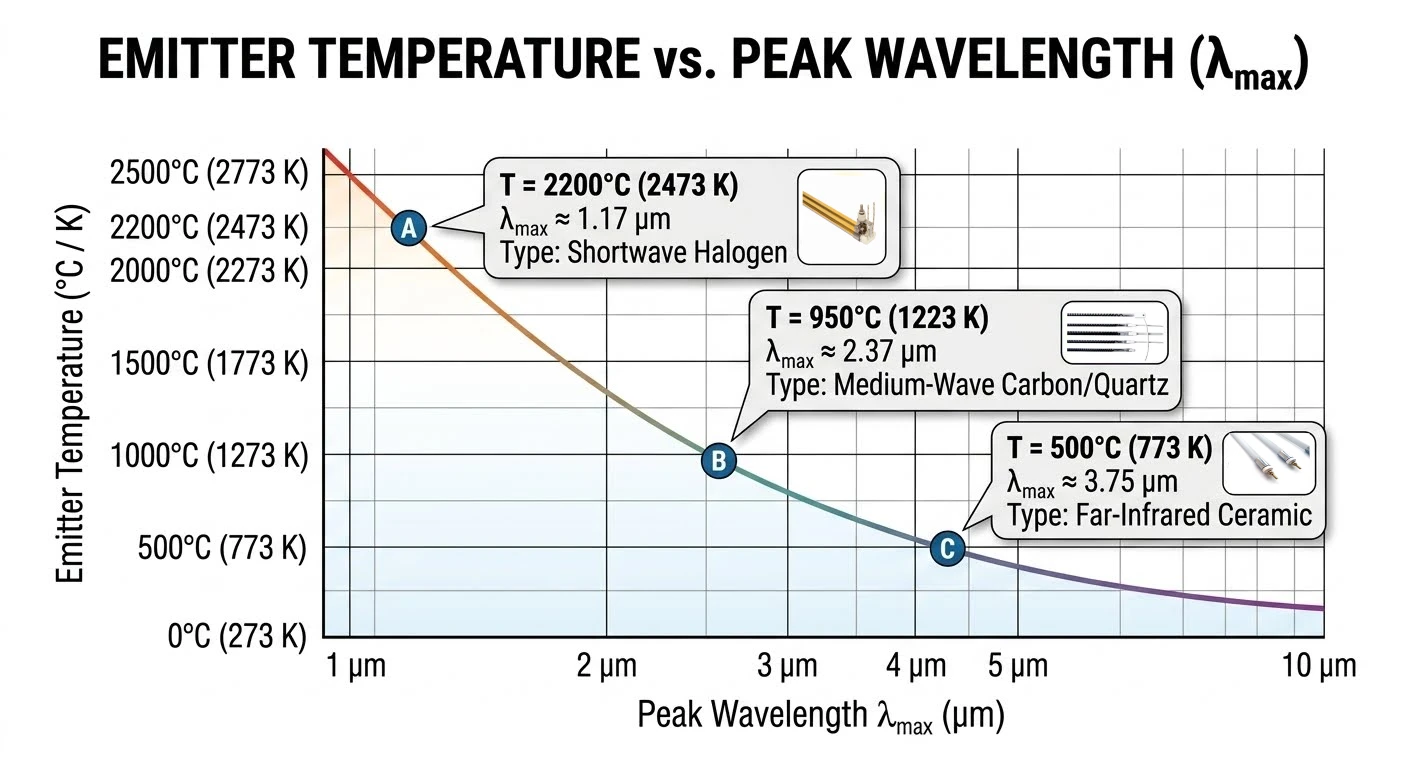
Wien's Law calculates the exact peak wavelength (λmax) of an emitter based on its surface temperature:
λmax = b / T
b: Wien's constant (≈ 2898 µm·K)
T: Absolute temperature in Kelvin (K = °C + 273.15)
2.2 Shortwave Infrared (0.78 µm – 1.4 µm)
Core Design: Halogen-filled clear quartz tubes with tungsten filaments operating at 1800°C–2400°C.
Thermal Behavior: Instantaneous response (< 1 second). High penetration capability suitable for metals, thin plastic films, and high-speed printing lines.
2.3 Medium-Wave Infrared (1.4 µm – 4.0 µm)
Core Design: Carbon fiber or nickel-chromium coils in quartz tubes operating at 800°C–1500°C.
Thermal Behavior: Rapid response (1–5 seconds). Highly efficient for water drying, powder coatings, PET blow molding, and paper processing.
2.4 Long-Wave / Far-Infrared (> 4.0 µm)
Core Design: Solid ceramic elements or dark-body infrared emitters operating at 300°C–750°C.
Thermal Behavior: Uniform surface absorption. Ideal for heavy plastic thermoforming, textile curing, and organic film heating.
For detailed emitter specifications across quartz and carbon fiber lamp geometries, explore Quartz & Carbon Fiber Infrared Lamps: Wavelength & Curing Guide.
3. Surface Emissivity & Conservation of Energy
When radiant electromagnetic energy hits a product surface, total incident energy (Qincident) splits according to three physical properties:
1 = ε + ρ + τ
Emissivity (ε) / Absorptivity (α): The efficiency with which a surface absorbs or emits thermal radiation (where α = ε at thermal equilibrium).
Reflectance (ρ): The ratio of radiation reflected off the target (e.g., polished aluminum mirrors reflect ~95% of IR energy).
Transmissivity (τ): The ratio of radiation passing directly through the target without absorption (e.g., clear thin films).
Emissivity Values for Common Industrial Materials
| Substrate Material | Surface Finish / State | Typical Emissivity (ε) | Target IR Wavelength Band |
| Water / Coatings | Wet Film / Droplets | 0.95 – 0.98 | Medium-Wave (2.7 µm & 6.0 µm Peaks) |
| Polymers (PET, PVC, PE) | Solid Sheet / Resin | 0.85 – 0.95 | Medium / Long-Wave (3.4 µm C-H Peak) |
| Anodized Aluminum | Matte / Colored | 0.77 – 0.85 | Shortwave / Fast Medium-Wave |
| Stainless Steel | Bright Polish | 0.05 – 0.15 | Medium-Wave (Requires Reflective Cavity) |
| Paper & Wood | Raw Cellulose | 0.88 – 0.94 | Medium-Wave / Carbon Fiber |
When specifying cylindrical band heaters for extruder barrels rather than open-space infrared emitters, consult Ceramic Band Heaters for High-Temp Extrusion: Engineering Guide.
4. Substrate Absorption Spectra & Molecular Resonance
The key to achieving high thermal efficiency is matching the emitter's peak wavelength (λmax) to the target material's natural Absorption Spectrum.
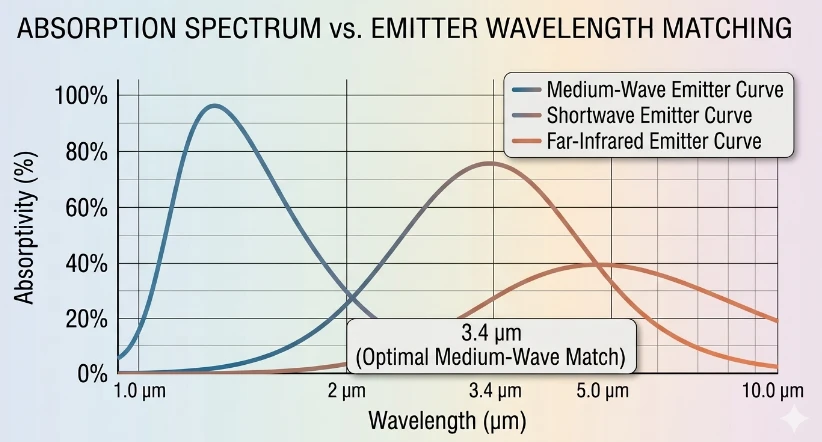
Molecular Bond Resonance: Organic polymers, paints, adhesives, and textiles contain C-H, O-H, and N-H atomic bonds. These molecular bonds vibrate at natural frequencies matching medium-wave infrared wavelengths (2.5 µm to 4.0 µm).
Efficiency Gains: Tuning the heater wavelength directly to the material's peak absorption band converts over 85%+ of electrical energy into direct internal thermal energy, drastically speeding up curing cycles and lowering power costs.
For heavy-duty vacuum thermoforming and continuous sheet heating, check Ceramic Infrared Emitters: Guide for Thermoforming & Industrial Drying.
5. System Integration & Custom Hongtai OEM Capabilities
Hongtai Alloy factory manufactures specialized Hongtai infrared heaters and multi-zone radiant modules for demanding OEM machinery:
Reflective Back Coatings: 90%+ pure gold or high-purity ceramic white coatings applied to the rear half of quartz tubes redirect 95% of rearward radiation toward the workpiece.
Custom Tube Geometries: Single-tube, twin-tube (11x23 mm / 15x33 mm), U-shape, or Omega-shape tube configurations engineered for custom thermal arrays.
Zoned Thermal Control: Multi-circuit element layouts for precise transverse temperature profiling across wide conveyor lines.
For pressurized liquid processing or vessel immersion applications, engineers can refer to Flange Immersion Heaters: Thermodynamics & Sheath Metallurgy.
Frequently Asked Questions (FAQ)
Q1: How does industrial infrared heating work compared to convection ovens?
Convection ovens heat air surrounding a product and rely on fluid movement to transfer thermal energy slowly. Infrared heating transfers electromagnetic radiation directly from the emitter to the target material, eliminating air preheating, reducing warm-up times, and transferring heat up to 10 times faster.
Q2: What is emissivity and why is it important in infrared heating?
Emissivity (ε) measures a material's efficiency in emitting and absorbing thermal radiation on a scale from 0.0 to 1.0. Materials with high emissivity (like plastics, paper, and water; ε > 0.85) absorb infrared energy rapidly. Low-emissivity materials (like polished metals; ε < 0.20) reflect energy, requiring enclosed reflective oven chambers or specialized wavelength tuning.
Q3: Why are gold reflectors applied to Hongtai quartz IR lamps?
Pure gold reflects up to 98% of infrared radiation. Applying a gold coating directly to the rear side of a quartz tube redirects rearward thermal energy forward onto the target product, preventing heat loss to the oven frame and reducing electrical power consumption by 30%–40%.
Ready to optimize your thermal process line and cut energy costs?
Hongtai Alloy factory designs high-performance Hongtai infrared heaters matched precisely to your substrate absorption characteristics and machine specifications.
[Download Hongtai Industrial Infrared Heating Technical Manual & Selection Guide]