

Thermal management in industrial settings isn't just about throwing raw wattage at a cold surface. Whether you are preventing lithium plating in a frozen battery pack or maintaining the flow of viscous resins, you need precise, directed heat that respects the physical limits of your equipment.
This is where a flexible industrial heater excels. Unlike rigid metal elements, vulcanized silicone rubber allows engineers to wrap uniform heat directly around complex geometries. However, at Hongtai Heater Factory, we often see OEMs make a critical mistake: they calculate the required wattage but ignore the substrate's thermal limits and mounting constraints.
Specifying the right industrial silicone heater requires evaluating your target surface, temperature limits, and available space. This guide breaks down the engineering boundaries for several core industrial applications.
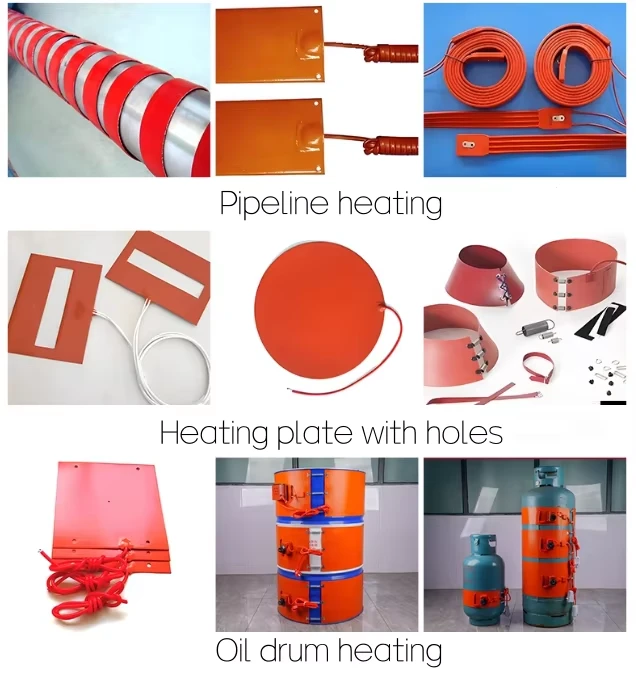
1.Battery Thermal Management in Sub-Zero Environments
Lithium-ion battery packs, energy storage systems (ESS), and EV modules suffer severe capacity drops in freezing conditions. To maintain safe charging temperatures, engineers typically integrate a custom silicone heater for batteries between cell modules or under the battery tray.
- The Hongtai Engineering Boundary: Battery cells are highly sensitive to thermal runaway. You cannot simply apply a high-power heater. The design must utilize an extremely low watt density (often less than 0.2 W/cm²) to guarantee gentle, even heat without localized hot spots.
- Space Constraints: Because ESS enclosures are densely packed, we typically recommend an etched-foil internal circuit. It provides an ultra-thin profile (often less than 1 mm), allowing it to slide into tight clearances while responding instantly to the Battery Management System (BMS).

2.Viscosity Control for Tanks and Chemical Equipment
Heavy oils, syrups, and chemical precursors must be kept warm to prevent crystallization and reduce pump strain. A silicone heater for tanks provides broad, uniform surface coverage that efficiently drives heat through the tank wall and into the fluid.
- Chemical Compatibility: When specifying a silicone heater for chemical equipment, remember that while silicone naturally resists moisture and many mild solvents, it is not invincible. Chemical compatibility must be verified for your specific fluid and concentration. For washdown areas, Hongtai manufactures these heaters with specialized overmolds and sealed lead exits to meet IP65 ratings.
- Plastic vs. Steel: The allowable heat output depends on what your tank is made of. Steel tanks dissipate heat quickly, but if you are heating an HDPE plastic tank, Hongtai engineers will strictly limit the watt density to prevent the plastic from softening or melting. (For more on sizing heaters for standard drums, see our Silicone Drum Heater Selection Guide).
3.Heat Tracing for Complex Pipes, Valves, and Flanges
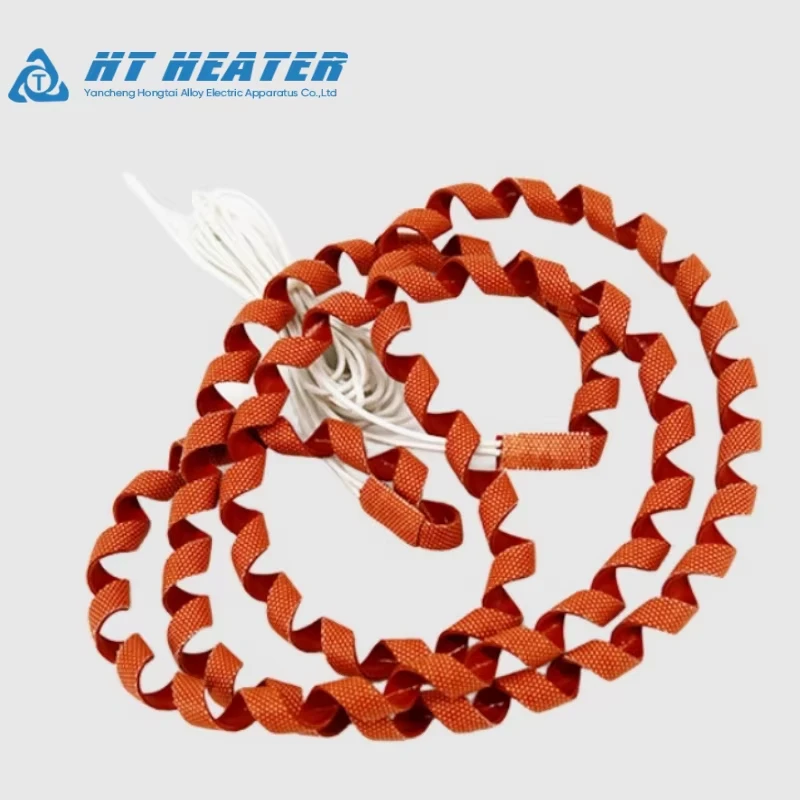
Moving heated fluids through a cold facility requires continuous heat tracing. While straight pipes are easy to insulate, valves, pumps, and flanges have irregular 3D shapes and heavy thermal masses, turning them into system cold spots.
Standard rigid heaters fail here because they leave insulating air gaps. A flexible silicone heater or tightly wrapped silicone tape ensures intimate contact with valve bodies. Because a heavy steel valve absorbs heat differently than a thin pipe, Hongtai recommends zoning these heaters with their own integrated temperature sensors to prevent under-heating the valve or over-heating the pipe. (Read more in our Silicone Heater Tape for Pipes Guide).
4.Precision Heating for Lab, Medical, and Mold Equipment
Not all heating applications are about freeze protection. Analytical instruments, medical incubators, and composite curing molds require exact temperature uniformity, often within a fraction of a degree.
For these high-precision scenarios, Hongtai utilizes etched-foil circuits designed with custom power distribution patterns. For example, we can engineer the heater to deliver more wattage at the edges of a laboratory platen to compensate for ambient heat loss, ensuring the center remains perfectly uniform. Note that if your equipment operates in a high-vacuum or cleanroom environment, you must request specialized post-baking processes to minimize material outgassing.
5.How to Calculate Thermal Load (The Basics)
Determining your heater's specifications starts with the thermal load. Do not just guess the wattage. You need to calculate the energy required to heat your mass (m) with its specific heat (cp) over your desired temperature rise (Tf - Ti):
Qload = m * cp * (Tf - Ti)
To find the average power required over your target heat-up time (t), you must also add the environmental heat loss (Ploss):
Pavg ≈ (Qload / t) + Ploss
A Warning from Hongtai Engineering: This Pavg is just your baseline. The final rated power of the heater must factor in a safety margin, the thermal resistance of your substrate, and the maximum allowable watt density. (For a deep dive into these calculations, visit our Silicone Rubber Heater Watt Density Guide).
6.Hongtai OEM Specification Checklist
To move from a concept to a functional prototype, we need specific data. Before requesting a quote from Hongtai Heater Factory, please prepare the following parameters:
- Application and Substrate: What are we heating? (e.g., EV Battery, Steel Tank, PVC Pipe)
- Dimensions: Max length, width, bend radius, and locations for any required cut-outs.
- Temperatures: Initial ambient temp, target temp, and the absolute maximum temp your substrate can survive.
- Electrical: Supply voltage (12V, 120V, 240V, etc.) and target wattage.
- Mounting: Pressure-sensitive adhesive (PSA), vulcanization, or mechanical springs? (See our Silicone Heater Installation Guide).
- Control: Integrated PT100, thermocouple, or thermostat? (Review our Silicone Rubber Heater Temperature Control Guide).

Partner with Hongtai for Specifying Your Custom Industrial Silicone Heater
Every industrial assembly has unique spatial, electrical, and thermal constraints. Whether you need a low-profile foil heater for an ESS enclosure or an IP65-rated wrap for a chemical vessel, engineering the thermal parameters upfront guarantees long-term reliability.
Translating theoretical heat load calculations into a robust physical installation requires evaluating substrate compatibility, environmental factors, and precise control logic. When specifying your next flexible industrial heater, provide your substrate material, operating temperatures, dimensions, and electrical constraints.
The engineering team at Hongtai Heater Factory can design custom silicone heaters equipped with tailored watt densities, vulcanized sensors, and application-specific mounting configurations.
[Contact Hongtai Engineering with Your Custom Heater Specifications]
Frequently Asked Questions (FAQ)
Q1: Can I immerse a silicone heater directly into my chemical tank?
No. While they are highly moisture-resistant, silicone heaters are designed as surface heaters to be mounted on the exterior of a tank, hopper, or pipe. They are not engineered for direct immersion in process fluids.
Q2: Why does Hongtai ask for my tank material before quoting the wattage?
Because the substrate dictates safety. A 1000W heater might work perfectly on a steel tank, but applying that same 1000W heater to a plastic (HDPE) tank could melt the wall. We use your substrate material to determine the maximum safe watt density.
Q3: Can your heaters fit around existing bolts, nozzles, or brackets on my equipment?
Yes. Because we manufacture the heaters from raw silicone and custom-cut foil/wire, Hongtai can design the heater with specific holes, notches, and cut-outs to perfectly navigate around your existing hardware without damaging the internal heating circuit.