

"Should the heater be permanently bonded to the equipment, or should it be removable for service and maintenance?"
This is often the first question to answer when selecting between a silicone heating pad and a silicone rubber heating blanket. While both are flexible electric heaters, they are engineered around fundamentally different installation conditions and thermal dynamics.
A thin flexible heating pad is typically specified where close, direct contact with a defined metal surface is critical. A heating blanket is more appropriate when the heater must wrap around larger objects, accommodate repeated removal, or incorporate integrated insulation. Selection is therefore not merely a matter of total wattage or thickness-it depends on the thermal transfer path, mounting interface, heated area, heat loss, and temperature control logic.

1.Structural Comparison: Close-Fitting Pads vs. Removable Blankets
The basic construction of both products utilizes fiberglass-reinforced silicone rubber insulation with an embedded resistance heating element. The primary difference lies in how the heater is configured for installation and heat transfer.
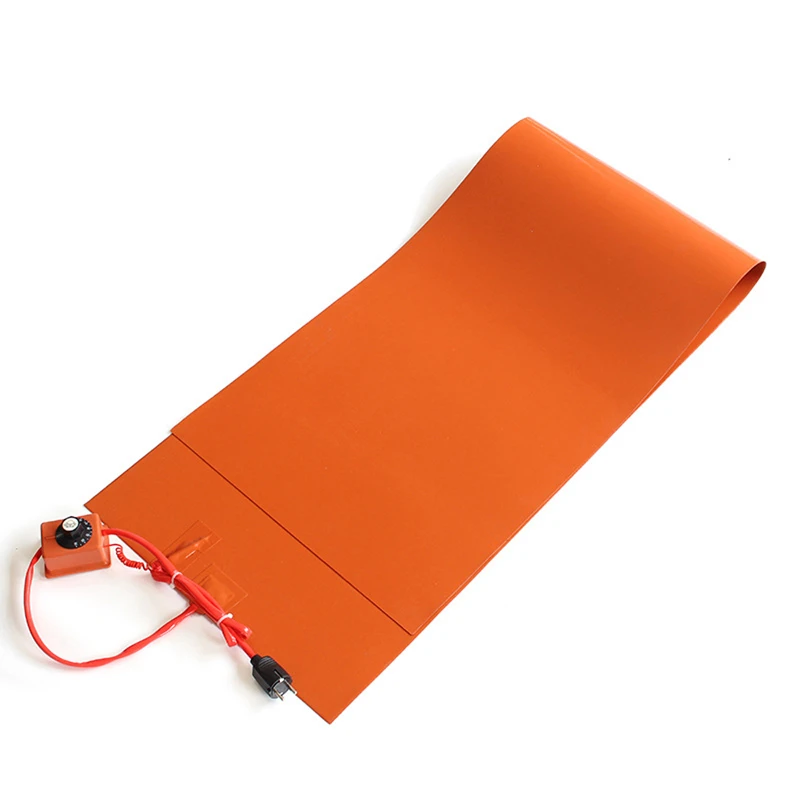
1.1 Silicone Rubber Heating Pad
A silicone rubber heating pad is designed as a thin, close-fitting heating element with minimal thermal mass.
- Element Construction: Available with etched foil or wire-wound resistance elements. Etched foil provides exceptional pattern precision and uniform heat distribution across defined surfaces, while wire-wound construction offers physical durability for flexing applications.
- Physical Profile: Typically about 1.5 mm thick, allowing it to conform tightly to flat, curved, or cylindrical components.
- Mounting Interface: Installed using pressure-sensitive adhesive (PSA), mechanical clamping, or factory vulcanization for a permanent, zero-clearance bond.

1.2 Silicone Rubber Heating Blanket
A silicone rubber heating blanket is configured for larger, removable, or heavy-duty heating applications.
- Element Construction: Primarily uses multi-strand wire-wound resistance elements to handle repeated physical manipulation and thermal expansion.
- Integrated Layers: Often incorporates closed-cell silicone sponge insulation layers (3 mm to 10+ mm thick) to reduce radiation loss to ambient air.
- Mounting Interface: Fitted with quick-release hardware such as adjustable straps, buckles, spring fasteners, or hook-and-loop closures rather than permanent adhesive bonding.
2.Thermal Path, Watt Density, and Mounting Interfaces
The same electrical wattage can produce drastically different operating temperatures depending on how the heater is installed. Consider a 750 W heater: if tightly bonded to a machined aluminum plate, heat quickly transfers into the substrate. If loosely wrapped around a surface with air gaps, heat accumulates within the heater body, leading to thermal degradation.
Thermal transfer follows a defined path:
Heating Element → Silicone Layer → Mounting Interface → Workpiece
Every interface adds thermal resistance. Minimizing air gaps is critical for a bonded heating pad. For a removable heating blanket, some surface clearance is unavoidable, requiring the thermal design to account for contact pressure and convective heat loss.
Watt density (WD) defines the power concentration per unit of active heating area:
WD = P / A
Where:
- WD = Watt density (W/cm²)
- P = Total heater power (W)
- A = Active heating area (cm²)
For example, a 500 W heater with an active heating area of 1,000 cm² operates at 0.5 W/cm². However, watt density alone does not dictate heater safety. Allowable limits depend on substrate material, thermal conductivity, mounting tightness, insulation, and the speed of the temperature-control loop(for precise thermal load evaluation, see our silicone heater watt density calculation guide).
3.OEM Application Profiles: Custom Pads vs. Industrial Blankets
3.1 Custom Silicone Heating Pads
A custom silicone heating pad is the ideal solution when a heating element must be seamlessly integrated into OEM machinery with strictly limited installation space. Because these pads are permanently bonded or mechanically fastened to a heat-sinking substrate (such as an aluminum plate or steel housing), they offer high thermal conductivity. This allows them to safely operate at higher watt densities, typically ranging from 0.5 to 1.0+ W/cm².
During the design phase, engineers can specify pads with cutouts, relief notches, or 3D molded shapes to accommodate internal sensors and mechanical components. Manufacturers can fully customize the dimensions, lead-wire exits, internal resistance traces, and integrated sensors.
Typical OEM Applications: Aluminum heating platens, medical analytical instruments, battery thermal management packs, semiconductor processing tools, and 3D printer build plates.
3.2 Silicone Rubber Heating Blankets
Silicone rubber heating blankets are the practical choice when vessels or equipment require routine maintenance, inspection, cleaning, or when heating large outdoor structures. These blankets are specifically designed to wrap around large-volume containers, such as 55-gallon drums, IBC totes, or large storage tanks.
Since strap-on installations inevitably create small air gaps across large surface areas, heating blankets generally operate at lower watt densities-typically between 0.1 to 0.3 W/cm²-to prevent local overheating and material degradation.
- Typical Industrial Applications: 55-gallon drum warming, IBC tote heating, process tank temperature maintenance, composite material curing, and freeze protection for outdoor piping and valves.
4.Engineering Comparison & Practical Decision Guide
To evaluate whether a heating pad or a blanket fits your thermal assembly, review the technical comparison and decision criteria below.
| Technical Factor | Silicone Rubber Heating Pad | Silicone Rubber Heating Blanket |
| Primary Design | Close-fitting, low-profile surface heater | Wrap-around, removable surface heater |
| Mounting Options | PSA (3M adhesive), factory vulcanization, clamping | Straps, buckles, quick-release springs, Velcro |
| Surface Conformity | High (for precision flat or smooth curved surfaces) | High (for large tanks, drums, and cylinders) |
| Removability | Low (typically permanent or semi-permanent) | High (designed for frequent installation cycles) |
| Integrated Insulation | Uninsulated (requires external insulation if needed) | Frequently includes integrated silicone sponge insulation |
| Thermal Response | Rapid heat transfer directly to substrate | Dependent on contact pressure and insulation layers |
Practical Decision Matrix
| Recommended Starting Point | Application Requirement |
| Custom silicone heating pad | Thin, permanent surface heating on machined parts |
| Complex mechanical outline with holes/cutouts | |
| High-precision thermal distribution across a platen | |
| Silicone rubber heating blanket | Large industrial drum or tank heating |
| Frequent removal for vessel cleaning or inspection | |
| Freeze protection with integrated insulation |
5.Specification Checklist for OEM Engineering
When specifying a custom flexible heater with an application engineer, providing comprehensive mechanical, electrical, and thermal parameters ensures an accurate thermal design:
- Mechanical: Overall length/width, active heated area, surface shape, mounting method, required flexibility, mounting holes/cutouts.
- Electrical: Supply voltage, total wattage, target resistance, number of heating zones, lead-wire exit location and wire type.
- Thermal: Target process temperature, ambient temperature limits, required heat-up time, heated mass/material properties, insulation thickness.
- Temperature Control: Integrated sensors (thermostat, Type J/K thermocouple, PT100 RTD) and high-limit thermal protection switches (refer to our silicone heater temperature control guide for loop integration).
Custom Silicone Heater Engineering at Hongtai
For OEM equipment design, choosing between a heating pad and a heating blanket is ultimately about how the element interacts with your assembly. Hongtai Heater Factory customizes flexible silicone heating elements according to your required dimensions, voltage, watt density, mounting interface, and integrated sensor configurations.