

Selecting the correct heating filament and gas atmosphere inside a quartz tube dictates continuous process reliability, energy transfer efficiency, and lamp operational lifespan. Industrial designers frequently face premature bulb failure, uneven web curing, or excessive power consumption due to misaligning filament properties (Tungsten vs. NiCr Alloy vs. Carbon Fiber) with application speed and substrate absorption.
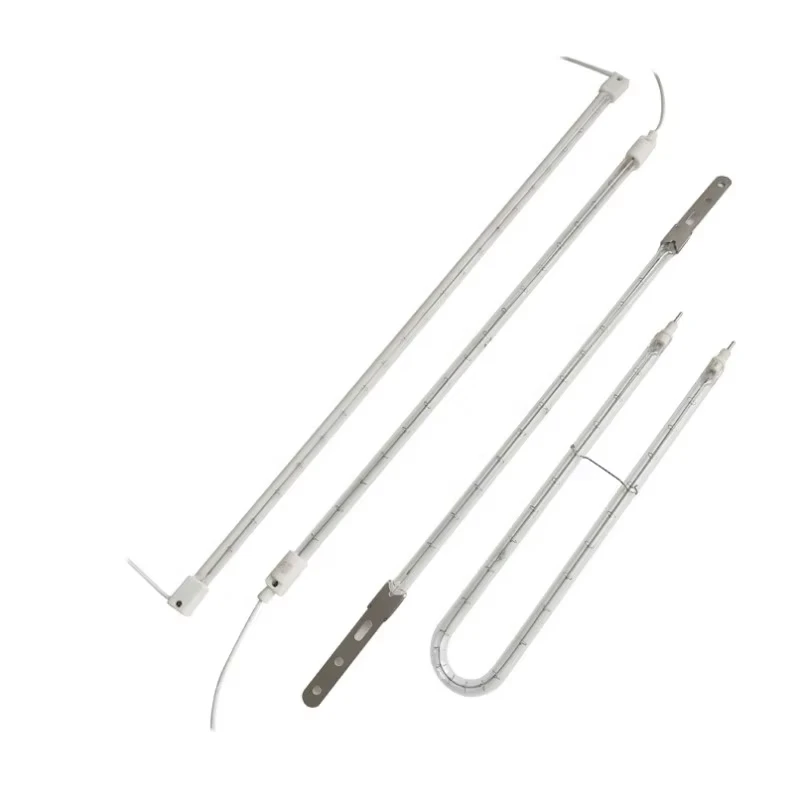
To deliver long-term operational stability and precise spectral matching, Hongtai Alloy factory manufactures custom-engineered Hongtai infrared heaters. Engineered using high-purity clear/ruby quartz glass, gold/ceramic reflectors, and precision-wound filaments, Hongtai quartz heating tubes deliver:
Tailored Filament Metallurgy: Options including high-purity tungsten, nickel-chromium (Ni80Cr20) alloy coils, and braided woven carbon fiber threads.
Optimized Spectral Wavelengths: Precise output spanning shortwave (0.78–1.4 µm), fast medium-wave (1.4–2.0 µm), and carbon medium-wave (2.0–4.0 µm).
High Thermal Mass Stability: High-purity quartz envelopes capable of withstanding thermal shocks over 1000°C without devitrification.
1. Technical Disassembly: Construction & Operating Principles
Every quartz infrared heating tube relies on an internal resistance element hermetically sealed within a high-purity silica glass envelope. However, internal chemistry and filament material create distinct physical characteristics.
1.1 Halogen-Filled Tungsten Tubes (Shortwave)
Filament Material: High-density coiled tungsten wire.
Internal Atmosphere: Inert gas (Argon/Nitrogen) mixed with halogen gas (Iodine/Bromine) under positive pressure.
The Halogen Cycle: As tungsten evaporates at temperatures above 2000°C, it reacts with halogen gas to form volatile tungsten halides. When these halides circulate near the hot filament, they decompose, redepositing tungsten back onto the filament and preventing bulb wall blackening.

1.2 Non-Halogen Tungsten & NiCr Quartz Tubes (Fast Medium-Wave)
Filament Material: Nickel-Chromium (Ni80Cr20) or standard tungsten coils.
Internal Atmosphere: Vacuum or low-pressure inert gas without halogen additives.
Thermal Profile: Operates at lower filament temperatures (800°C–1200°C), shifting peak emission into the fast medium-wave spectrum.
1.3 Carbon Fiber Quartz Tubes (Medium-Wave)
Filament Material: Braided carbon fiber thread woven from high-purity carbon micro-filaments.
Internal Atmosphere: Hermetically sealed under deep vacuum with protective inert buffer gas.
Molecular Advantage: Carbon fiber features low thermal expansion, near-zero resistance drift over lifetime, and high spectral emissivity (> 0.95), producing pure medium-wave radiation ideal for organic absorption.

For high-precision mold and die heating where solid surface conduction is required rather than quartz tube radiation, engineers should review High-Density Cartridge Heaters: Precision Mold Engineering Guide.
2. Technical Comparison Matrix: Halogen vs. Tungsten vs. Carbon Fiber
| Specification Parameter | Halogen Quartz Tube | Standard Tungsten Tube | NiCr Wire Quartz Tube | Carbon Fiber Quartz Tube |
| Peak Wavelength ($\lambda_{max}$) | 0.78 – 1.4 µm (Shortwave) | 1.2 – 1.8 µm (NIR / Fast MW) | 1.4 – 2.4 µm (Fast MW) | 2.0 – 4.0 µm (Medium-Wave) |
| Filament Operating Temp | 1800°C – 2400°C | 1400°C – 1800°C | 900°C – 1100°C | 800°C – 1200°C |
| Thermal Response Time | < 1 Second (Instant) | 1 – 2 Seconds | 2 – 4 Seconds | 1 – 3 Seconds (Fast Medium) |
| Inrush Current Multiplier | 10x – 15x (Cold Resistance) | 8x – 12x | 1.0x – 1.1x (Stable) | 1.0x – 1.05x (Negligible) |
| Average Rated Lifespan | 5,000 Hours | 5,000 Hours | 8,000 Hours | 10,000+ Hours |
| Radiant Heat Efficiency | Up to 90% | Up to 85% | Up to 80% | Up to 88% (High Organic Match) |
| Visible Light Glare | High (Bright White/Yellow) | Moderate (Orange) | Low (Dull Red) | Ultra-Low (Soft Dark Red) |
When choosing between wavebands and material absorption characteristics across short, medium, and long-wave emitters, consult Short-Wave vs Medium-Wave vs Long-Wave Infrared Heaters: Engineering Selection Guide.
3. Engineering Performance Selection Criteria
Selecting the ideal quartz heating tube requires evaluating key electrical, mechanical, and optical parameters.
3.1 Inrush Current & Power Supply Sizing
Tungsten & Halogen Lamps: Tungsten exhibits a strong positive temperature coefficient of resistance (PTC). Cold filament resistance is up to 1/15th of hot resistance, causing massive initial current surges during cold startup. Electrical panels require oversized Solid State Relays (SSR) or soft-start Phase-Angle SCR Power Controllers.
Carbon Fiber & NiCr Tubes: Carbon fiber has a slight negative temperature coefficient that quickly stabilizes. Inrush current is virtually non-existent (~1.0x rated current), simplifying circuit breaker and relay sizing.
3.2 Spectral Matching to Material Absorption
Water Evaporation & Paint Curing: Water has major molecular absorption bands at 2.7 µm and 6.0 µm. Carbon fiber infrared heaters emit directly within the 2.0–4.0 µm band, maximizing moisture removal speed while saving up to 30% electrical power compared to shortwave halogen lamps.
PET Preform Blow Molding: PET plastic requires deep, uniform volumetric heating without burning the surface. Halogen quartz heaters and fast medium-wave tungsten lamps provide deep photon penetration required for stretch blow molding processes.
For standard fundamental principles of infrared radiation, Stefan-Boltzmann equations, and Wien's Law calculations, explore Industrial Infrared Heating: How It Works & Engineering Guide.
4. Operational Application Matrix for Machine Designers
Use this selection table to specify the optimal quartz heating tube for target machinery:
| Application Industry | Process Requirements | Optimal Quartz Tube Type | Key System Advantage |
| PET Bottle Blow Molding | Rapid volumetric wall heating | Halogen Shortwave Quartz Tube | High energy density and deep penetration through clear PET preforms. |
| Water-Based Ink & Paper Drying | High surface water evaporation | Carbon Fiber Medium-Wave Tube | Matches 2.7 µm water absorption peak; zero inrush current surge. |
| Automotive Paint & Powder Repair | Rapid curing with instant stop | Halogen Twin-Tube with Gold Reflector | Instant ON/OFF response prevents paint scorching when conveyor stops. |
| Plastic Thermoforming & Sheet Heating | Soft uniform surface heating | NiCr Fast Medium-Wave Quartz Tube | Gentle surface heating prevents surface bubbling or polymer degradation. |
| Semiconductor & Solar Wafer Processing | High-purity thermal annealing | High-Purity Quartz Tungsten Lamp | Ultra-clean quartz sleeve prevents process contamination during rapid thermal processing (RTP). |
When specifying cylindrical band heaters for extruder barrels or heated injection nozzles rather than open radiant tubes, refer to Ceramic Band Heaters for High-Temp Extrusion: Engineering Guide.
5. System Integration & Custom Hongtai OEM Capabilities
Hongtai Alloy factory manufactures custom Hongtai infrared heaters and quartz tube assemblies to fit exact OEM machine specifications:
Integrated Reflective Gold/Ceramic Coatings: Pure 24K gold or high-purity ceramic white coatings bonded directly onto the rear hemisphere of the quartz tube direct 95% of emitted energy forward.
Custom Tube Cross-Sections: Available in single round tubes (Ø10 mm, Ø12 mm, Ø18 mm) and heavy-duty twin-tube profiles (11x23 mm and 15x33 mm) for high mechanical rigidity over long spans.
Lead Terminal Configurations: Custom ceramic caps, wire leads, R7s, metal clip leads, or fast-disconnect terminals designed for easy maintenance replacement.
When designing liquid immersion systems or pressurized vessel heating instead of open air radiation, review Flange Immersion Heaters: Thermodynamics & Sheath Metallurgy.
Frequently Asked Questions (FAQ)
Q1: What is the main operational advantage of a carbon fiber infrared heater over a halogen halogen tube?
Carbon fiber emitters produce medium-wave radiation (2.0–4.0 µm) that perfectly matches the natural absorption frequencies of organic materials, polymers, and water. Additionally, carbon fiber has virtually no cold inrush current surge, protecting electrical switches and extending operating lifespan up to 10,000+ hours.
Q2: Why are halogen quartz lamps filled with halogen gas instead of regular inert gas?
Halogen gas initiates the "halogen regenerative cycle." Evaporated tungsten particles combine with halogen gas inside the tube and are redeposited back onto the hot tungsten filament instead of clinging to the glass wall. This prevents glass blackening and allows operating temperatures up to 2400°C.
Q3: How does a gold reflector coating on a quartz IR lamp save energy?
Applying a 24K gold coating directly to the rear half of a quartz glass tube reflects up to 98% of rearward infrared radiation back toward the product. This eliminates the need for external metal reflectors, reduces heat loss into the oven frame, and cuts power consumption by 30%–40%.
Ready to upgrade your industrial heating tubes and lower power costs?
Hongtai Alloy factory manufactures high-performance Hongtai infrared heaters customized to your exact wavelength, voltage, and geometry requirements.
[Download Hongtai Quartz Infrared Lamp Technical Catalog & Engineering Drawings]