

Heating air inside a recirculating industrial oven or continuous dryer is fundamentally different from heating fresh makeup air in a standard HVAC duct. Dropping a standard ambient duct element into a high-temperature curing oven or moisture-heavy drying tunnel frequently leads to premature sheath oxidation, overheated electrical terminals, and unstable chamber temperatures.
Specifying finned tubular heaters for industrial ovens and dryers requires accounting for three distinct airflow streams, reduced air density at elevated temperatures, moisture or solvent loads, insulated wall penetrations, and process contaminants. This guide provides a structured engineering framework to size, select, and customize stainless steel and high-alloy finned elements for industrial ovens and dryers.
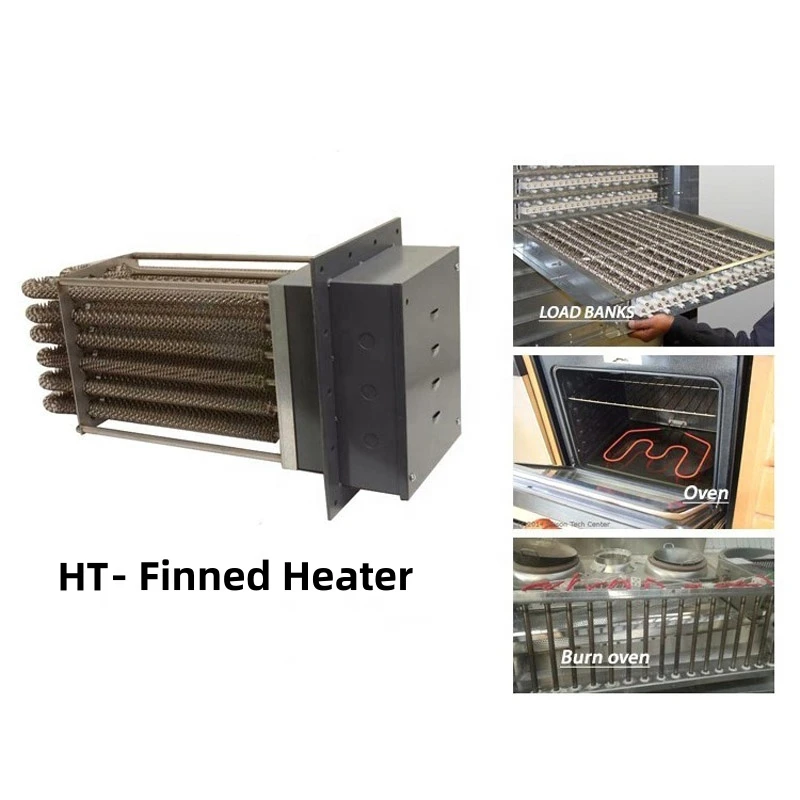
1. Engineering Principle: Why Recirculating Ovens Punish Standard Duct Heaters
Unlike once-through HVAC ducts, industrial ovens and dryers manage three interconnected airflows that must never be treated as a single volume:
- Recirculation Airflow: Moves heat from the heater bank to the workload and determines local cooling velocity across the fins.
- Exhaust Airflow: Removes evaporated moisture, curing fumes, or solvent vapors from the chamber.
- Makeup Airflow: Replaces exhausted air with cooler ambient air, creating a major continuous heating load.
This closed-loop architecture introduces three thermal challenges:
- Elevated Inlet Temperatures: Air returning to the heater bank is already hot (determined by chamber heat balance, workload absorption, and makeup ratio). A smaller temperature difference between the sheath and incoming air forces higher sheath temperatures to dissipate the same kilowatt load.
- Lower Air Density at High Temperatures: Blowers move a fixed volume of air, not a fixed mass. For dry air at constant atmospheric pressure (ideal gas approximation), density drops from roughly 1.20 kg/m3 at 20°C to about 0.67 kg/m3 at 250°C. Because density and viscosity shift with temperature, mass flow rate and flow regime change across the fins, directly affecting finned heater heat transfer .
- Latent Load & Thermal Cycling: Dryers must supply both sensible heat and moisture evaporation energy, while batch ovens cycle repeatedly between ambient and operating temperatures, stressing fin bonds and mounting hardware.
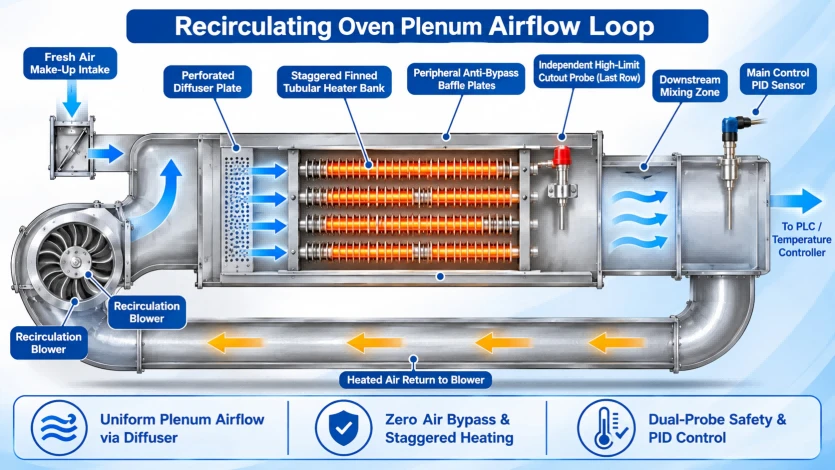
2. Key Design Parameters for Oven & Dryer Finned Heaters
Reliable performance in an industrial dryer heater or curing oven depends on six coupled parameters:
- Sheath Temperature vs. Chamber Temperature: The element sheath always runs hotter than the oven air. Actual sheath temperature depends on watt density, local air velocity, tube diameter, and fin geometry-and must be verified via manufacturer curves or testing rather than assumed. Note that finned elements have different surface-temperature limits than bare tubular elements.
- Allowable Watt Density: Hotter, lower-density recirculating air reduces cooling capacity. Check your target finned heater watt density (Suggested Internal Link: Finned Heater Watt Density) against worst-case local air velocity and maximum allowable sheath temperature.
- Atmosphere-Matched Metallurgy: Do not select SUS304, SUS316L, SUS321, SUS310S, or Incoloy 800/840 from a generic temperature table alone. Evaluate oxidation resistance alongside humidity, chlorides, acidic vapors, curing resins, and washdown chemicals.
- Fin Pitch & Attachment Integrity: Sticky curing vapors, lint, or heavy moisture require wider fin pitch to minimize fouling and condensate trapping. Under frequent batch cycling, furnace-brazed or heavy-tension-wound fins help maintain tight thermal contact. (See finned tubular heater fin design).
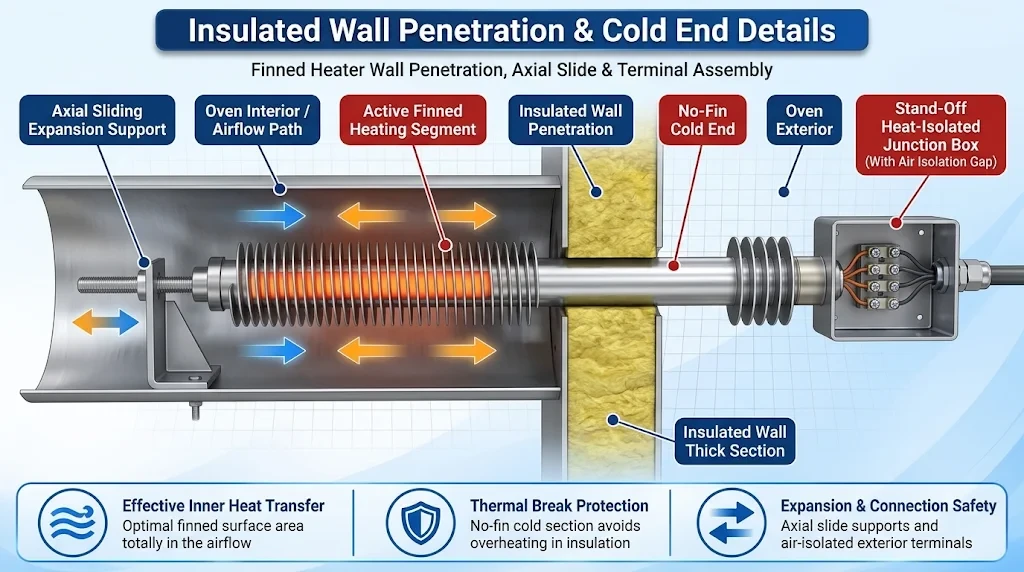
- Cold-End Length (Wall Penetration): Size the unheated, unfinned cold zone to match the actual oven wall insulation thickness, mounting flange, and terminal box standoff so heat is never trapped inside the wall cavity.
- Thermal Expansion Allowance: Long elements expand noticeably at oven temperatures. Rigidly locking both ends can cause tube bowing, bracket stress, or mechanical damage; use sliding supports where required.
3. Calculation & Comparison: Oven & Dryer Heat Load
3.1 Drying Moisture Rate & Oven Heat Balance
In industrial drying, first calculate the required water evaporation rate using dry-basis moisture content:
mdot,w = mdot,dry × (Xin - Xout)
- mdot,w: Moisture evaporation rate (kg/s)
- mdot,dry: Mass flow rate of bone-dry product (kg/s)
- Xin, Xout: Inlet and outlet moisture content (kg water / kg dry solid)
The total thermal load sums four components:
Qtotal = Qproduct + Qracks + Qexhaust + Qwall (+ Qevap for wet dryers)
- Product / Rack Sensible Load: Q = (m * Cp * ΔT) / t
- Exhaust Makeup Air Load: Qexhaust = mdot,air * Cpair * ΔT
- Wall Heat Loss: Qwall = (U * Awall * ΔT) / 1,000
- Evaporation Load (Dryers): Qevap = mdot,w * Δh (Note: ~2,260 kJ/kg is only an approximation for water at 100°C and 1 atm; rigorous drying calculations should use actual water-to-vapor enthalpy change or a psychrometric chart.)
Worked Example (Batch Curing Oven):
An oven heats 500 kg of steel parts plus 150 kg of steel racks (Cp = 0.49 kJ/kg·°C) from 20°C to 200°C (ΔT = 180°C) in 1 hour (3,600 s). Wall area is 25 m2 (U = 0.35 W/m2·K). To vent curing fumes, the system draws 600 m3/h of ambient makeup air measured at 20°C and 1 atm (dry air density ~1.20 kg/m3, giving mdot,air= 0.20 kg/s; Cp ~1.01 kJ/kg·°C).
- Steel Parts: (500 * 0.49 * 180) / 3,600 = 12.25 kW
- Steel Racks: (150 * 0.49 * 180) / 3,600 = 3.68 kW
- Exhaust Makeup Air: 0.20 * 1.01 * 180 = 36.36 kW
- Wall Loss: (0.35 * 25 * 180) / 1,000 = 1.58 kW
- Total Startup Load: 53.87 kW | Steady-State Holding Load: 37.94 kW
Engineering Takeaway: Exhaust makeup air often dominates oven power demand, and holding power is well below startup power. Always verify flow measurement temperature and pressure before converting volumetric flow to mass flow. (For full airflow formulas, see air heater power calculation).
3.2 Comparison: HVAC Duct Heater vs. Recirculating Oven/Dryer Heater
| Engineering Factor | Once-Through HVAC Duct Heater | Recirculating Oven / Dryer Heater |
| Inlet Air Temperature | Ambient (-20°C to +40°C) | Elevated recirculating air |
| Air Density at Elements | High (near standard conditions) | Reduced at elevated temperatures |
| Watt Density Selection | Higher (cool incoming air) | Verified & derated for high inlet temp |
| Cold-End Design | Short (thin duct wall) | Extended to clear insulated oven walls |
| Terminal Box Protection | Standard enclosure | Insulated standoff or ventilated box |
| Process Contaminants | General dust / mild humidity | Steam, resins, acids, solvents, food residue |
4. Common Mistakes in Oven & Dryer Heater Design
- Using Ambient Watt-Density Charts for Hot Recirculating Air: Ignoring elevated inlet temperatures and lower air density causes unexpected sheath overheating.
- Undersized Cold Zones: Allowing the active heating coil to sit inside wall insulation traps heat, overheating the sheath behind the flange and degrading terminal wiring.
- Treating SCR Control as a Cure-All: SCR proportional control improves modulation, but preventing overshoot still requires proper sensor placement, PID tuning, manageable thermal inertia, and sound industrial air heater layout.
- Ignoring Chemical Outgassing & Fouling: Choosing SUS304 purely by temperature fails in chloride-rich food dryers, while overly tight fin pitch clogs rapidly in resin or lint-heavy tunnels.
- Overlooking Hazardous Atmosphere Codes: Never install standard industrial finned heaters in ovens handling flammable solvent vapors or combustible dust without a formal hazard assessment, area classification, compliant ventilation/purge interlocks, and appropriately rated electrical equipment.
5. Selection Guide: Matching Finned Heaters to Oven & Dryer Types
| Application Type | Typical Operating Focus | Metallurgy & Fin Strategy | Control & Safety Essentials |
| Moisture / Food Dryer | High humidity, washdown, chlorides | SUS304 or SUS316L (per corrosion spec); wide fin pitch for drainage/cleaning | Airflow proving switch + moisture-sealed terminal box |
| Powder / Paint Curing Oven | Resin outgassing, batch cycling | SUS304 or SUS321 sheath; moderate-to-wide pitch; brazed or tight-wound | Exhaust & recirculation interlocks + hazard-code review if solvents present |
| High-Temp Aging / Heat-Treat Oven | High sheath temp, low air density | SUS321, SUS310S, or Incoloy 800/840 sheath; high-temp fins; furnace-brazed | Derated watt density + independent high-limit temperature sensors for PLC and PID controllers |
| Continuous Conveyor Tunnel | Multi-zone heat-up & holding loads | Zone-matched alloys & fin pitch; side-withdrawal frames for maintenance | Zoned PID/SCR control + interleaved staging |
6. OEM Application: Custom Hardware & Replacement Measurement Guide
Standard catalog tubes rarely match custom oven wall thicknesses, plenum footprints, or terminal clearances. At Hongtai Heater Factory, we manufacture custom finned tubular heater assemblies-including straight, U-shaped, W-shaped, and multi-bend elements (common tube diameters such as 8 mm or 11 mm), as well as complete insulated plug-in heater banks with pre-wired 3-phase busbars and integrated thermowells compatible with your industrial temperature probe design.
OEM Sizing & Replacement Measurement Checklist (RFQ):
- Process & Airflow Data: Chamber temperature, recirculation/exhaust/makeup flow rates (with reference temp/pressure), and product/moisture load.
- Atmosphere & Safety: Presence of steam, corrosive vapors, lint, washdown, or flammable solvents/dust (specify required safety certifications).
- Element Geometry (for New Builds or Replacements): Shape (straight, U, W), base tube OD, fin OD/pitch, active finned length, unheated cold-end length, and center-to-center leg spacing.
- Wall & Mounting Details: Insulated wall thickness, mounting style (threaded fittings, welded plate, or insulated plug-in frame), and terminal box type.
- Electrical & Control Specs: Voltage, phase, kW per element/bank, staging or SCR control, and temperature sensors for PLC and PID controllers (Suggested Internal Link: Temperature Sensors for PID Controllers and PLCs) integration.
Engineer Your Oven & Dryer Heaters with Hongtai
Building a dependable oven finned heater or industrial dryer heater means aligning heat balance, air density, alloy metallurgy, cold-zone geometry, and safety interlocks to your real process conditions. Whether you are designing a new multi-zone curing oven or sourcing precision replacement elements for existing drying equipment, our engineering team can help you verify specifications and manufacture custom finned assemblies built for reliable operation.
[Contact Hongtai Engineering to Specify Your Custom Oven & Dryer Finned Heaters.]