

In non-standard industrial tanks, commercial cleaning baths, and OEM drying ovens, off-the-shelf straight or standard immersion heaters fail to fit constrained geometric footprints. Bending heating elements into complex 2D and 3D shapes solves spatial limitations, but aggressive bend radii introduce severe failure modes: core resistance wire eccentricity, compacted dielectric magnesium oxide (MgO) thinning, and localized breakdown. This technical whitepaper details the bending physics of tubular heating elements, compares anti-corrosion sheath metallurgy (304, 316L, Incoloy 840), and outlines specialized mounting hardware-including compression fittings, brazed bulkheads, and mini-flanges.

1. Core Mechanics & Bending Failure Modes in Non-Standard Geometries
For OEM equipment R&D engineers, industrial washing equipment manufacturers, and custom thermal system designers, bending tubular elements without strict mechanical controls leads to major internal failures:
Internal Resistance Coil Eccentricity: When a tubular heater is bent around a tight radius, the outer wall stretches while the inner wall compresses. This force pulls the internal nickel-chromium resistance wire away from the center axis toward the inner sheath wall.
Dielectric MgO Thinning: The insulating MgO layer at the inner bend radius becomes compacted unevenly or thinned out. Under high voltage, the reduced dielectric distance leads to immediate arc-over and catastrophic sheath burnout.
Sheath Micro-Cracking: Cold-working stainless steel beyond its elongation limit introduces micro-fractures along the outer bend radius, exposing internal MgO insulation to fluid ingress and short circuits.
2. Custom Product Gallery
Tailoring tubular elements to match vessel geometry ensures uniform fluid heat transfer and eliminates stagnant cold spots. Below are key custom element shapes engineered for specific OEM installation requirements:
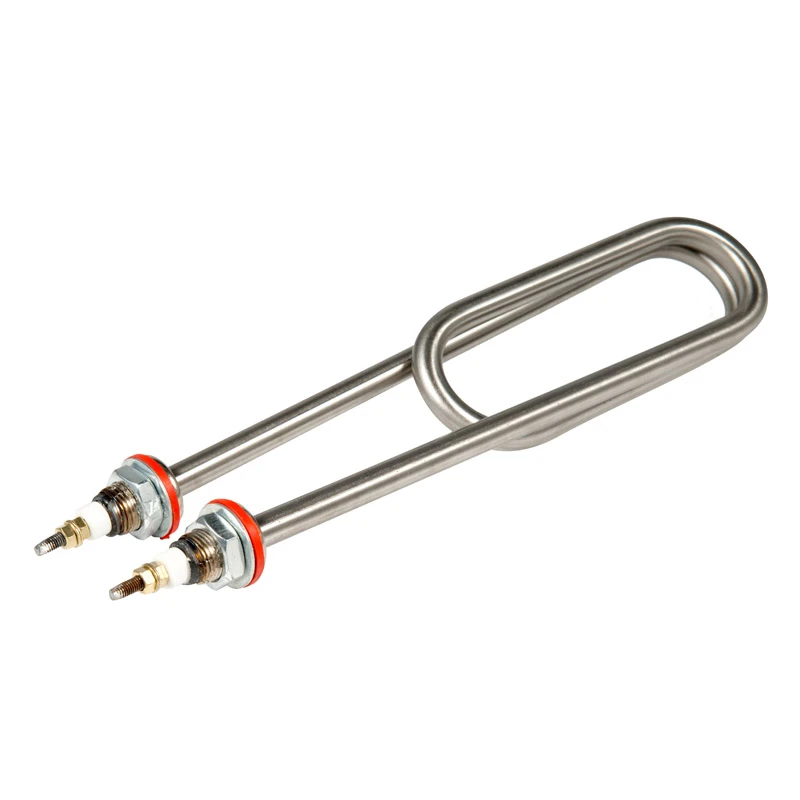
2.1 Standard U-Shaped (Single-Bend) Elements

Design Features: Simple 180-degree hairpin turn providing two parallel heating legs. Equipped with factory-welded threaded brass or stainless steel bushings, hex locknuts, and high-temperature silicone sealing washers.
Ideal Applications: Standard fluid immersion, water heating tanks, oil sumps, and compact laboratory stills where straight-line insertion is available.
2.2 Helical / Spiral Coiled Tubular Elements

Design Features: Concentric multi-turn helical winding delivering massive active sheath surface area within a compact cylindrical volume. Integrated threaded fittings maintain liquid-tight bulkhead mounts.
Ideal Applications: High-flow inline liquid heaters, commercial beverage/coffee boilers, hot water circulating cylinders, and vertical flow-through chambers.
2.3 L-Shaped / Right-Angle Multi-Pass Element Bundles

Design Features: Precision 90-degree right-angle bend separating the vertical cold leg from the horizontal active heating legs. Allows electrical terminal connections to remain safely above high fluid levels while heat generation sits along the vessel floor.
I
deal Applications: Shallow wash tanks, ultrasonic cleaning vats, side-wall tank immersion, and liquid reservoirs with low overhead clearance.
2.4 Double U-Shaped / M-Folded Hairpin Elements
Design Features: Dual 180-degree return bends forming an M-shaped profile. Doubles the effective wattage density and heated length within a constrained horizontal width.
Ideal Applications: Commercial deep fryers, industrial wash basins, rectangular boiling pans, and compact liquid process tanks.
2.5 Serpentine / W-Shaped Flat Grid Elements

Design Features: Planar serpentine (zig-zag) multi-loop geometry engineered for multi-pass surface heat coverage across broad flat areas. Fitted with heavy-duty hex nipples and high-temperature electrical terminal studs.
Ideal Applications: Flat-bottom vat heating, forced-air duct heating assemblies, industrial drying ovens, and large-surface heating platens.
2.6 Multi-Geometry Custom OEM Element Portfolio

Design Features: Diverse non-standard bending configurations-including fine-pitch spring coils, multi-turn serpentines, extended cold legs, and specialized threaded plugs.
Ideal Applications: Custom OEM machinery, non-standard processing vessels, packaging seal bars, and specialized thermal equipment requiring tailored CAD geometry.
2.7 Hand-Formable Flexible Tubular / Manifold Heaters

Design Features: Malleable, formable sheath design that can be pressed or hand-bent directly into 2D/3D milled grooves, hot runner manifolds, or irregular tool channels without pre-forming dies. Features high dielectric strength and flexible insulated lead terminations.
Ideal Applications: Plastic injection mold hot runner manifolds, 3D contour mold heating, packaging sealing jaws, and custom tooling dies.
3.Minimum Bend Radius Limits & Geometry Engineering
To maintain uniform dielectric insulation thickness and centered wire position after rotary forming, custom bending geometries must adhere to mandatory bend radius limits.
The absolute minimum center-line bend radius (Rmin) is determined by the outer diameter (Douter) of the tubular sheath:
Rmin ≥ 2.5 × Douter
Standard Industrial Tubing Example: For an 8.0 mm outer diameter tubular element, the absolute minimum center-line bend radius is 20.0 mm.
Unheated Bend Zone Requirement: High-watt density heating coils must not extend into sharp bends. Specify an unheated cold section along tight bend arcs to prevent localized thermal accumulation.
4. Metallurgy & Corrosion Resistance Profile
Selecting the correct alloy for custom-formed elements ensures chemical compatibility with cleaning agents, process fluids, or high-temperature humid air.
| Sheath Metallurgy | Max Operating Temp | Corrosion & Chemical Profile | Typical OEM Application |
| 304 Stainless Steel | 400°C | Moderate (Clean water, passive air heating) | Industrial baking ovens, fresh water rinse tanks |
| 316L Stainless Steel | 500°C | High (Low-carbon content resists pitting & mild acids) | Ultrasonic cleaning tanks, food processing, medical washers |
| Incoloy 840 / 800 | 750°C | Superior (Exceptional resistance to oxidation & stress corrosion) | High-temperature humid ducts, thermal fluid boilers |
| Titanium Alloys | 300°C | Immune to chloride, saltwater, and harsh acids | Anodizing plating baths, seawater circulation systems |
5. Custom Mounting & Termination Fittings
Custom tubular heaters require leak-proof, strain-relieved mounting interfaces to integrate seamlessly into OEM machinery walls.
Threaded Hex Bushings / Nipples: NPT, Metric, or BSPP threaded fittings silver-brazed or TIG-welded directly onto the element sheath ends. Allows simple screw-in installation through tank walls.
Double-Ferrule Compression Fittings: Swagelok-style compression fittings clamped onto straight sheath legs. Ideal for field-adjustable immersion depths without permanent welding.
Brazed Mounting Plates & Mini-Flanges: Custom stamped or CNC-machined mounting plates configured with O-ring grooves or bolt hole layouts for rapid assembly in production lines.
Hermetic Terminal Moisture Seals: High-temperature silicone potting or ceramic-to-metal seals prevent washdown fluids and moisture vapor from contaminating the internal MgO dielectric core.
6. OEM Engineering Workflow & Sizing Verification
Submit CAD Geometry & 3D Footprint: Provide 2D/3D step files showing tank entry clearances, required bend radiuses, and terminal positioning.
Verify Medium & Watt Density Limits: Check maximum surface heat loading based on process fluid properties by referencing Screw Plug Immersion Heaters: Thread Sealing & Viscosity Sizing and Heavy-Duty Flange Immersion Heaters: Selection & Engineering Guide
Validate Overall Power Consumption: Calculate total wattage, thermal response time, and sheath surface loading using guidelines from The Engineer's Guide to Calculating Cartridge Heater Watt Density (2026 Edition).
If your OEM machinery, cleaning bath, or custom industrial curing system requires custom stainless steel tubular heating elements, precision 2D/3D bending, or specialized mounting hardware, submit your CAD drawings and fluid specs to our thermal design team for custom prototype manufacturing.
[Download Custom Stainless Steel Tubular Heater Engineering Sizing Guide & CAD Templates ]