

1. Introduction & Problem Statement
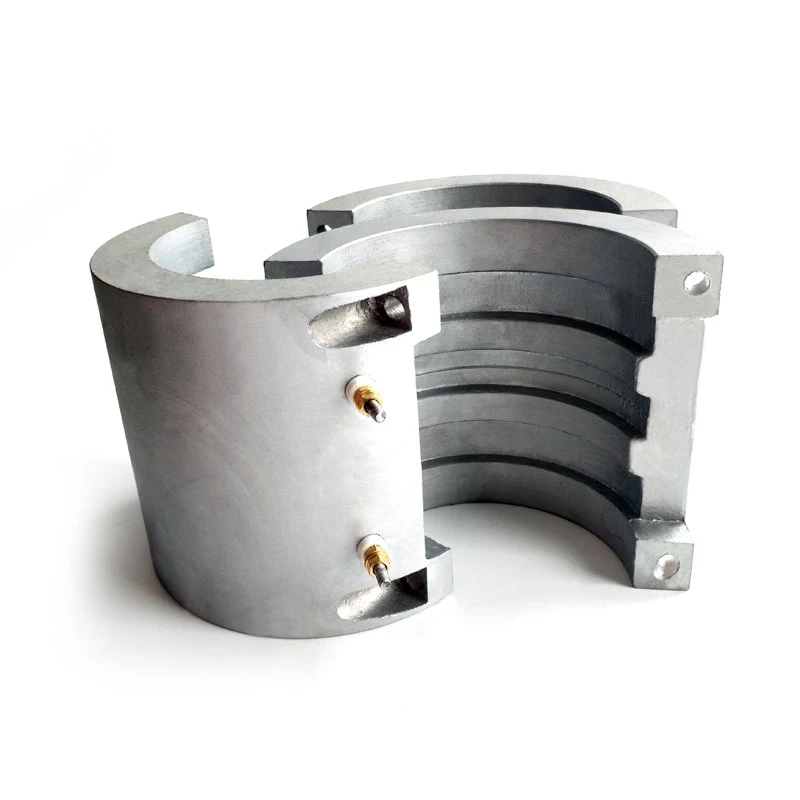
Cast-in heaters serve as the backbone for high-demand thermal processing equipment, including plastic extrusion barrels, blown film dies, vulcanization presses, and liquid-cooling heat exchangers. Unlike thin-profile sheet heaters that rely solely on conductive contact, cast-in elements encapsulate high-purity tubular heaters inside solid metallic matrices, providing superior structural integrity and high heat storage capacity.
In precision extrusion and processing of engineered resins (e.g., PEEK, Fluoropolymers, Nylon 66), temperature spikes or cold spots can cause shear stress variations, melt fracture, and thickness instability. Furthermore, uncontrolled exothermic reaction heat in barrel zones requires aggressive yet precise thermal dissipation.
1. Metallurgy & Alloy Selection
The choice of casting matrix dictates the maximum operating temperature, thermal conductivity (λ), mechanical strength, and corrosion resistance of the heater body.
| Alloy Type | Max Temp Limit | Thermal Conductivity (W/m⋅K) | Recommended Applications |
| Cast Aluminum (L319 / AlSi7Mg) | ≤400℃/750°F | ~130 - 160 | Standard plastic extrusion, food processing, packaging dies |
| Cast Bronze / Brass (CuZn39Pb3) | ≤650℃/1200°F | ~ 80 - 110 | High-temperature polymers (PEEK, PTFE), die casting |
| Cast Iron (Ductile / Nodular) | ≤450℃/840°F | ~45 - 50 | High-pressure platen presses, severe mechanical abrasion |
Cast Aluminum : Offers the highest thermal conductivity and rapid temperature response. However, exceeding 400℃ leads to matrix softening, creep deformation, and mechanical failure under clamping loads.
Cast Bronze / Brass : High thermal density and superior resistance to chemical attack and high temperature. Recommended when processing high-viscosity engineered plastics or operating under heavy clamping pressures.
2. Liquid-Cooling Tube Integration & Dual-Thermal Dynamics
In exothermic polymer extrusion processes, high-speed screw rotation generates massive frictional heat. Cast-in heaters often incorporate internal stainless steel or copper liquid-cooling tubes alongside the tubular heating elements.
Dual-Zone Thermal Dynamics: The cooling medium (water, glycol, or synthetic oil) flows through seamless cooling loops embedded directly into the casting. This enables active, precise heat extraction when frictional heating exceeds the process threshold.
Differential Expansion Protection: The cooling tube matrix must be engineered with heavy wall thickness (≥1.5mm) and specialized bending radii to withstand continuous thermal expansion and contraction cycles without fatigue cracking or internal delamination.
Comparison with Air-Cooled Band Systems: For lower thermal density systems or cylindrical extruders, air-cooled options may be used. Engineers should reference our guide on How to Correctly Install & Clamp Mica Band Heaters to Eliminate Air Gaps when evaluating air vs. liquid cooling trade-offs.
3. Machining Tolerances & Thermal Contact Impedance
Because cast-in heaters transfer energy strictly through physical contact with the barrel or die, thermal boundary contact resistance R contact is the single largest cause of localized hot spots and heater core burnout.
△T = q• R contact= q •[δ/(k air• A)]
Inner Diameter Precision : Castings must be precision CNC bored to fit the exact outer diameter (OD) of the mating barrel. Standard tolerances should be maintained within +0.05mm/ +0.15mm.
Surface Roughness (Ra): The contact surface must achieve a roughness rating of Ra≤3.2μm. Any gap exceeding 0.05mm acts as a thermal barrier, trapping heat inside the casting and accelerating element degradation.
Thermal Paste Utilization: High-temperature thermal transfer pastes (up to 500℃) must be applied thinly and uniformly during mounting to fill microscopic surface asperities.
4. Thermal Sizing, Watt Density, and PID Sensor Placement
Preventing internal heating wire failure requires balancing total thermal demand with structural surface heat flux.
Surface Watt Density Limits:
Cast Aluminum: Max 4 - 6W/cm2(25 - 40W/in2)
Cast Bronze / Brass: Max 6 - 9W/cm2 (40 - 60W/in2)
Calculating Thermal Flux: When sizing embedded tubular elements inside the matrix, engineers must verify internal core ratings using our established framework on surface watt density limits and heat flux calculations
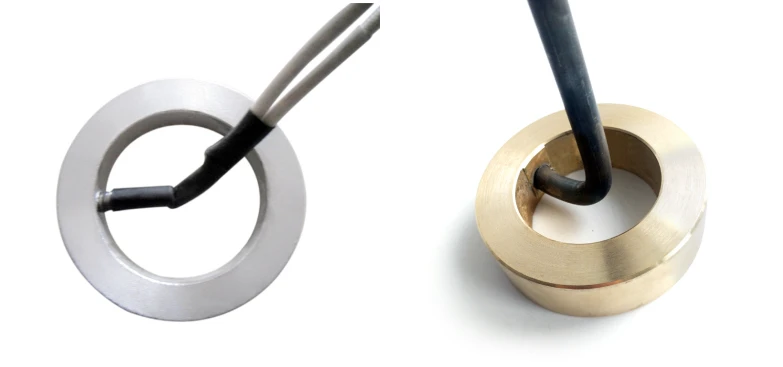
Closed-Loop Control: Embed control sensors deep within the casting wall near the heat source. For proper sensor selection and signal response times, consult our technical comparison of integrated Type K and Type J thermocouples . For micro-scale runner manifolds, cross-reference our analysis on Hot Runner Coil Heaters – Micro-Thermal Profiling and Swaging Mechanics .
5. Field Failure Modes & Engineering Best Practices
Porosity and Void Formation in Castings : Internal voids created during sand casting act as thermal insulators. When an embedded element touches a casting void, localized temperatures skyrocket, causing internal dielectric breakdown. Solution: Mandate 100% X-ray inspection or ultrasonic testing for critical aerospace and high-temperature bronze castings.
Bolting Torque & Thermal Creep : Cast aluminum softens under continuous operation, causing mounting bolts to lose torque over time. Loose heaters create air gaps, leading to sudden failure. Solution: Re-torque all mounting hardware after initial heat-up cycle and utilize spring-loaded washer assemblies (Belleville washers) to maintain constant clamping force.
Please feel free to contact us if you need customized precision aluminum casting heaters with strict tolerances, efficient thermal management systems with built-in liquid cooling circuits, or specialized technical support for the design of heat fields for extruders.
Our engineering team will provide you with a full-process solution from heat flux calculation, power density selection to failure prevention, ensuring that your production line achieves precise temperature control and efficient operation.
[https://www.ht-heater.com/contact-us/]