

Leveraging their ultimate form adaptability and excellent environmental resistance, flexible silicone rubber heating elements have become core actuators in modern industrial temperature control systems. This article aims to systematically analyze the underlying architecture of flexible heaters from the perspectives of materials science and thermodynamic design. It covers heating circuit topology selection (etched foil vs. wire-wound), mechanical reinforcement of composite materials, thermal boundary condition setting, interfacial thermal resistance control, and closed-loop safety integration, providing OEM engineers with a comprehensive technical reference spanning from component selection to mass production implementation.
1.Core Technology: Etched Foil vs. Wire-Wound Elements
Flexible silicone heaters rely on a resistance circuit sandwiched between two layers of fiberglass-reinforced silicone rubber. Choosing the right heating circuit technology is critical for performance and lifespan.
Technical Comparison Matrix
| Property | Etched Foil Heaters | Wire-Wound Heaters |
| Circuit Manufacturing | Photo-etched from a thin metal alloy sheet (Inconel, Constantan) | Resistance wire (NiCr) helically wound around a fiberglass core |
| Surface Area Coverage | High (up to 90% surface coverage); uniform heat flux | Lower; point or linear heat concentration |
| Power Density | Higher (< 5.0W/cm^2 with good bonding) | Lower (<0.8 – 1.5W/cm^2) |
| Flexibility & Durability | Excellent; thin profile with high tear resistance | Moderate; repeated flexing can fatigue the fine resistance wire |
| Ideal Application | Precision medical equipment, aerospace panels, fast ramp-up thermal plates | Large industrial drums, anti-condensation enclosures, low-cost prototypes |

2. Materials Science & Environmental Thresholds
Silicone rubber offers unique elastomeric properties combined with excellent chemical and moisture resistance.
2.1 Silicone Elastomer Layers and Reinforcement
Base Elastomer: High-consistency silicone rubber (HCR) or liquid silicone rubber (LSR) vulcanized under high pressure.
Fiberglass Scrim : Embedded between the two silicone sheets to provide dimensional stability, preventing the heater from stretching or deforming when subjected to thermal expansion or mechanical handling.
Temperature Operating Limits: Continuous operating range from -60°C to +200°C (special formulations up to +250°C).

2.2 Chemical & Moisture Resistance
Silicone heaters exhibit high resistance to moisture, humidity, weathering, and mild acids or fungus. However, they are sensitive to concentrated organic solvents, strong alkalis, and gasoline immersion over extended periods.
3. Mounting Engineering & Thermal Adhesion
Because flexible heaters have zero rigidity, full surface contact with the target substrate is mandatory to prevent air pockets and localized burnout.
3.1 Attachment Methods
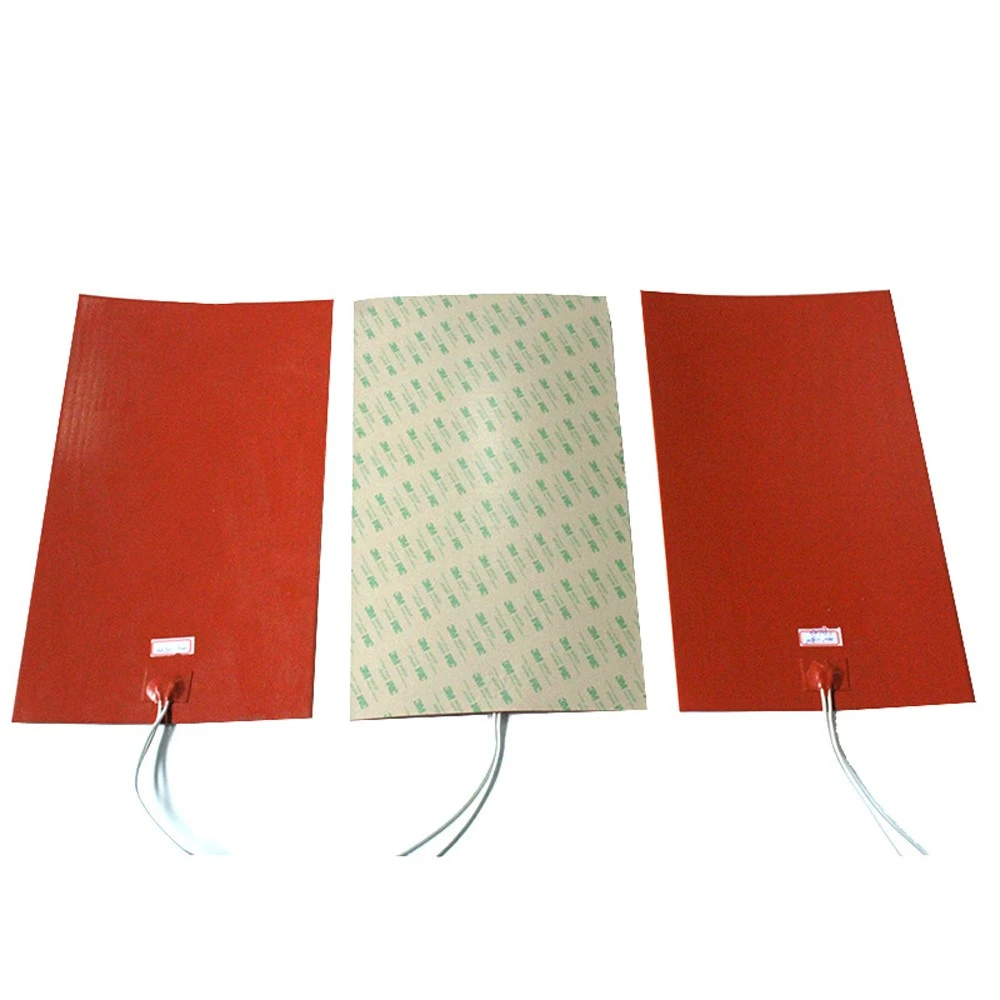
Pressure-Sensitive Adhesive (PSA): Factory-applied high-temperature acrylic adhesive (e.g., 3M 468MP). Suitable for continuous operating temperatures up to 150 °C(175 °C intermittent).
Vulcanization (Factory Vulcanizing): High-temperature vulcanization bonding directly onto metal substrates (aluminum or stainless steel plates) at the factory, yielding superior heat transfer and permanence.
Mechanical Clamping / Springs: Used for removable drum heaters or cylindrical pipes where adhesive bonding is impractical.
4. Thermal Control, Thermostats, and Safety Integration
To prevent thermal runaway or overheating on low-mass substrates, flexible heaters must incorporate precision sensing elements:
Integrated Sensors: Built-in PT100 RTD, NTC thermistors, or Type K / Type J thermocouples laminated directly into the active heating zone.
Thermal Cutoffs (TCO): Non-resettable thermal fuses embedded as a fail-safe against over-temperature events.
Quality Assurance Standards: All our silicone heaters must pass a 1200 V AC1200V AC dielectric strength test (1 min), an insulation resistance test ( ≥50 MΩ≥50MΩ at 500 V DC500V DC ), and an active surface thermal imaging uniformity scan
[Download Flexible Silicone Heater Engineering Guide & CAD Templates]