


Why Checking Your Thermocouple Matters
Temperature measurement flubs account for 30% of factory downtime and 25% of quality slips, per NIST's 2024 report. Skip routine checks, and you're rolling the dice-safety risks, compliance misses, wasted cash. This guide breaks down how to spot issues early. It also explains why Hongtai's thermocouples hold up better when put to the test.
Step 1: Visual Check-Catch Problems Before They Grow
Start with a once-over. Your eyes can spot red flags faster than any tool:
Sheath shape: Look for cracks, rust, or dents. Corroded sheaths-say, 304 stainless in acidic setups-can botch heat transfer by 40%, ASME tests show.
Junction gunk: Exposed junctions with oil, dust, or metal shavings? That's a 5–10°C reading error waiting to happen.
Wiring mess: Frayed wires, loose terminals, or greenish oxidation? Resistance over 1Ω means bad connections.
Hongtai's edge? Their thermocouples use seamless Inconel 600 sheaths-no weak welds like generic models. That cuts corrosion sneak-ins by 90%, so visual checks can stretch longer.
Step 2: Electrical Tests-Verify the Signal
Grab a multimeter. These three tests separate good thermocouples from duds:
Open circuit check: Touch probes to the two wires. A healthy thermocouple reads under 1Ω. Infinite resistance? The wire's broken-common in shakey spots like auto engine bays.
Polarity check: Red wire = positive, yellow = negative (industry standard, and Hongtai labels them clear). Flip them, and readings go haywire-15% of misdiagnoses trace to this, per Control Engineering.
Insulation test: Probe wire vs. sheath. Should read over 100 MΩ at 500V DC. Lower? Moisture snuck in, a top cause of flaky signals (22% of cases, IEC 60584-3 says).
Hongtai's fix? Thicker 0.3mm alloy cores-50% beefier than standard. Less breakage. Their pre-crimped terminals? No more polarity mix-ups during tests.
Step 3: Calibration Check-Make Sure It's Accurate
Grab a NIST-traceable thermometer. Test at mid-range (e.g., 400°C for K-type):
Class 1 rules: Allowed error is ±1.5°C (0–400°C) or ±0.4% of the reading (400–1260°C), per IEC 60584-2.
Drift watch: A 5% drop from the original reading? The alloy's wearing out. Uncalibrated thermocouples hit this after 1,000+ hours at 800°C.
Hongtai includes fcerts with every unit. Saves $50–$100 per thermocouple on third-party checks.
Step 4: Environment Check-Is It a Match?
Your thermocouple's got to fit where it works:
Temp limits: Stay within rated ranges (e.g., K-type handles -200°C to 1260°C). Push past? Life shrinks 20%+, NIST thermal tests prove.
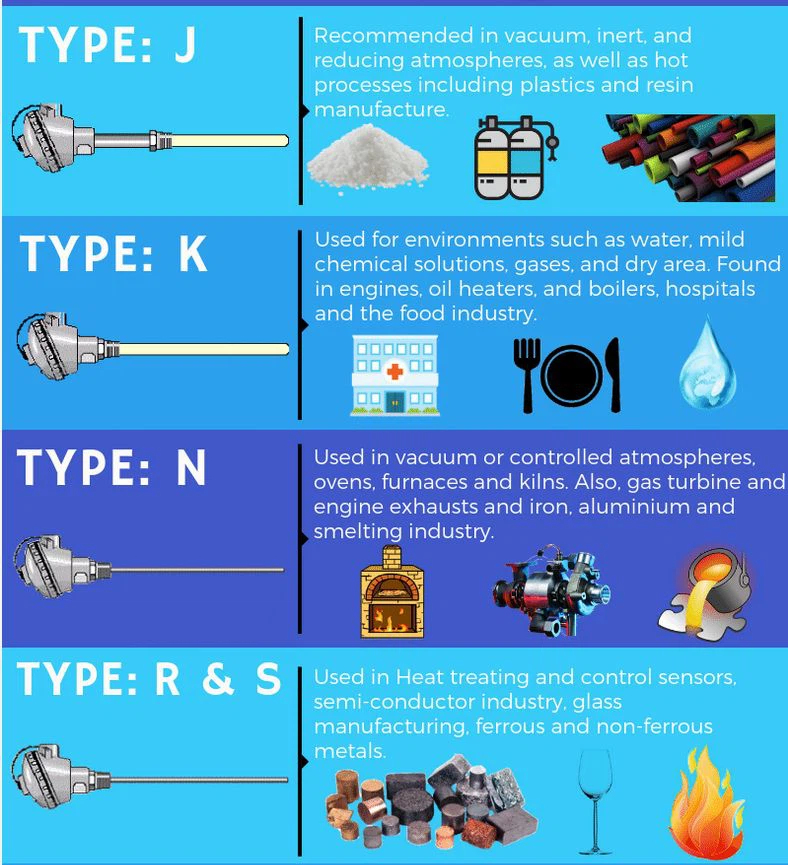
Atmosphere fit: Furnaces (oxidizing) need Inconel. Hydrogen (reducing) needs Type J or ceramic.
Hongtai offers 12+ sheath/insulation options-316L stainless for food plants, explosion-proof for risky zones. No one-size-fits-all fumbles.
Common Thermocouple Issues: Quick Fixes
| Problem | Cause | How to Check | Fix | Hongtai Advantage |
|---|---|---|---|---|
| Erratic readings | Electrical interference (VFDs) | Check signal with oscilloscope | Keep wires 30cm from power; use shielding | HT-K-M has copper braid-cuts EMI by 75% |
| Low readings | Gunked junction or rusted sheath | Visual check + resistance test | Clean with isopropyl; replace sheath | Seamless sheaths block 90% of gunk |
| No signal | Broken wire or loose terminal | Open circuit test + torque check | Replace wire; tighten to 5–8 N·m | Thicker cores + lock washers = fewer breaks |

Why Hongtai Makes Checks Easier
Tougher materials: 99.99% pure alloys (vs. 99.5% generic) mean 0.2% less drift over 5,000 hours at 1,000°C.
Smarter design: Grounded junctions in HT-K models stand up to 40% more vibration-great for auto test benches.
Backup: 5-year warranty (others give 1–2). A Texas refinery saved $20k per failure with their 24-hour replacements.
Keep It Proactive
Monthly: Use Hongtai's test strips to spot early corrosion.
Quarterly: Tighten terminals. Test insulation.
Annually: Full calibration. Track drift over time.
Checking a thermocouple doesn't have to be a hassle. Do it right, and you skip downtime. Pick Hongtai, and you skip more headaches-their build handles the abuse, so your checks stay quick and easy.
External Links:
IEC 60584 Thermocouple Standards: https://www.iec.ch/standardsseries/
NIST Thermal Testing Data: https://www.nist.gov