



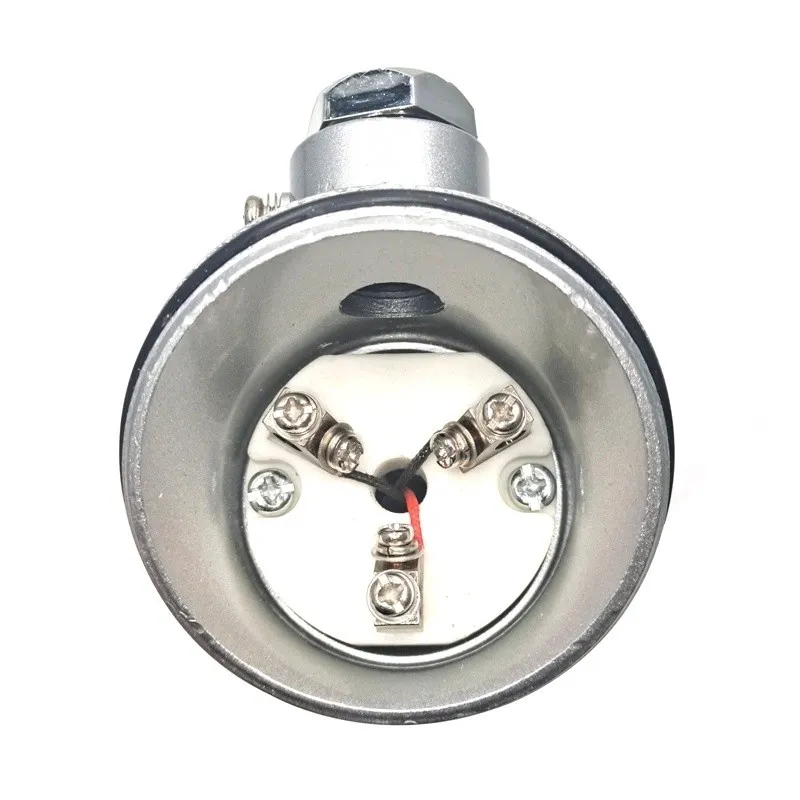


K-Type thermocouples are total workhorses in industrial temperature monitoring-reliable, budget-friendly, and tough enough for harsh shop floors. If you need accurate readings without the hassle, this is your go-to pick.
What Is a K-Type Thermocouple?
It's one of the most common industrial temp sensors, built with two distinct alloy wires:
Positive leg (+): Chromel (90% nickel, 10% chromium)
Negative leg (-): Alumel (95% nickel, 2% aluminum, 2% manganese, 1% silicon)
This combo isn't random-it has three big perks:
Consistency: Holds steady performance even with long-term use, so your data stays reliable.
Toughness: Handles oxidizing, inert, or dry environments without breaking down.
Versatility: Works from cryogenic cold to high heat-no need to swap sensors for different jobs.
It runs on the Seebeck effect-here's the simple version: the "hot junction" (the end you stick in your process) and "cold junction" (the reference end in the terminal box) sit at different temps. That difference creates a small voltage; hook it to a controller or thermometer, and it translates straight to a temp reading-no fancy math needed.

[K-Type Thermocouple diagram]
Key Technical Specs
| Parameter | Details |
|---|---|
| Temperature Range | -40°C to 1,200°C (-40°F to 2,192°F) standard; bare-wire hits 1,370°C (2,500°F) for short bursts |
| Sensitivity | ~41 µV/°C-varies a tiny bit with process conditions, but nothing to worry about |
| Standard Accuracy | ±2.5°C or ±0.75% of your reading (whichever is larger) |
| High-Precision (SLE) Accuracy | ±1.1°C or ±0.4% of your reading (whichever is larger)-for jobs where precision matters |
| Sheath Material Options | 316 SS (max 850°C), 310 SS (max 1,000°C), Inconel 600 (max 1,200°C), 347 SS, 446 SS, Alloy 160 HR |
| Tolerance Class | Class 1: 0-375°C (±1.5°C); 375-1,000°C (±0.004×temp)Class 2: 0-333°C (±2.5°C); 333-1,200°C (±0.0075×temp) |

[thermocouple connecting points]
Why It Works for Industrial Shops
Wide Temp Range
Covers everything from -40°C freezers (think cold storage) to 1,200°C furnaces (metal heat treatment). One sensor does the job of multiple-saves you time stocking spares and swapping units.
Fast Response
It's small and simple, so it doesn't hold onto heat. Bare-wire models pick up temp changes in seconds-perfect for dynamic jobs like metal annealing, where you need real-time data to keep processes on track.
Budget-Friendly
No rare metals here-easy to source, and costs about 40% less than high-end specialty sensors. You get solid performance without blowing your budget, which matters for small to mid-size shops.
Built to Last
Takes the abuse of industrial life: dust, vibration, even occasional bumps. The alloys resist oxidation, so it lasts longer in high-heat setups-fewer replacements mean less downtime.
Where It Fits in Your Shop
K-Type thermocouples work across industries-here's where they shine:
| Industry | Common Uses |
|---|---|
| Manufacturing | Furnaces, kilns, mold temp tracking, metal melting |
| Energy Sector | Boiler tubes in power plants, transformer temp checks |
| Chemical/Petrochemical | Reaction vessel monitoring (only in oxidizing atmospheres!) |
| Food Processing | Oven sterilization, cold storage (-40°C to 0°C works great) |
| Lab & Research | Incubators, cryogenic studies |
| HVAC | Duct and equipment temp control in commercial buildings |

[Collage of use cases (industrial furnace, food oven, lab setup, power plant boiler)]
Pro Tips for Use
To keep it accurate and long-lasting, stick to these:
Skip bad environments: Avoid reducing atmospheres, sulfur-rich spaces, or vacuums-they'll corrode the alloys fast.
Don't push high temps too long: Running it over 1,000°C nonstop can throw off voltage. Contact us if you need consistent precision at high heat.
Pick the right sheath: Use Inconel 600 for 1,200°C jobs; 316 SS works for lower-heat (≤800°C) corrosive setups.
Calibrate the cold junction: Keep the cold end at a known temp (or use a compensator)-otherwise, your readings will be off.
FAQs
Q1: How's a K-Type different from other thermocouples?
It's the sweet spot-wide temp range, affordable, and durable. No need to overspend on specialty sensors if this fits your needs; it's the most versatile pick for general industrial work.
Q2: What's sensitivity mean here?
~41 µV/°C-so for every 1°C temp change, it makes about 41 microvolts of voltage. Enough to give clear, reliable readings without extra gear.
Q3: How do I choose the right sheath material?
316 SS: General corrosive setups (max 800°C)
310 SS: High-heat oxidizing jobs (max 1,000°C)
Inconel 600: Extreme heat (max 1,200°C)-great for furnaces
Q4: Can it handle cryogenic temps?
Absolutely-standard models go down to -40°C, so they're perfect for freezers or refrigeration systems.

[Customization options checklist]
Quality & Support
Our K-Type thermocouples meet international standards (IEC 584-1, ASTM E230)-every unit gets calibrated before shipping (with a test report included). We can tweak length or sheath material to fit your setup, too.
Got questions? Our team knows industrial shops-we'll help you pick the right model fast.
Reach Out
Live Chat: Click the bottom-right icon-we're here to help fast.
Ready to upgrade your temp monitoring? Request a sample today-we'll get it out to you quick.

Hot Tags: k-type thermocouple, China, suppliers, manufacturers, factory, wholesale, price


